

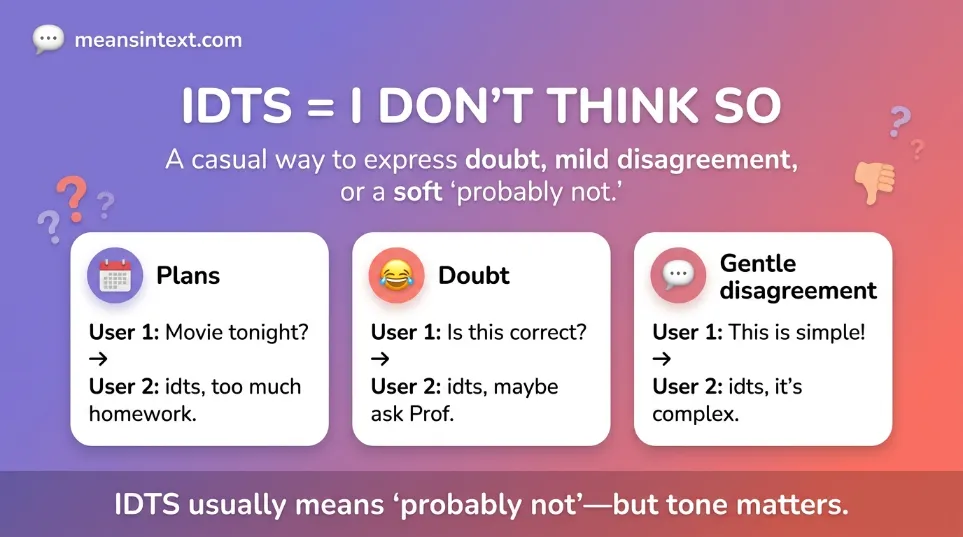
Quick Answer: IDTS stands for "I Don't Think So." People text it to politely disagree, doubt something, or say "probably not." It's a softer no than a flat "no," and it can sound playful or sarcastic depending on the emoji and punctuation that come with it.
You asked a simple question and got back IDTS. Was that a yes? A no? A shrug?
It’s a “probably not.” This guide explains what IDTS means, how to read its tone, and how to reply. You’ll also see real chat examples, polite ways to disagree, and a few mistakes to avoid.
What Does ‘IDTS’ Mean – Quick Meaning
IDTS stands for “I Don’t Think So.”
Simple breakdown:
- It expresses doubt or mild disagreement
- It’s softer than a flat “no” but clearer than “maybe”
- It’s used in texts, comments, and group chats
Example messages:
- “Is the store open on Sundays?” → “idts”
- “Think he’ll show up?” → “IDTS 😂”
- “Do you want to go?” → “idts, I’m too tired”
Origin & Background
IDTS comes from a phrase people have said for a very long time: “I don’t think so.” In speech, it’s a common polite way to say no. Writers of texts and chats shortened it to four letters to save time.
How the abbreviation formed
Texting culture loves initialisms. People type “idk” for “I don’t know” and “idc” for “I don’t care.” IDTS follows the same pattern. It takes the first letter of each word, “I Don’t Think So,” and joins them.
What the sources say
Many websites define IDTS as “I don’t think so,” and they agree on the basic meaning. Some claim it started in the early 2000s, but I couldn’t find a firm record of when it began. One low-quality page also lists “I don’t understand,” but the main reading is clearly “I don’t think so.” Treat the origin date as unknown.
Where it sits today
IDTS appears in group chats, TikTok comments, Instagram replies, and Snapchat. It’s less common than “idk” or “idc,” but it’s easy to understand once you know the phrase. Most people read it right away.
Real-Life Conversations
1. Text Message (Simple Answer) Person A: is the cafe open on Sunday? Person B: idts, they close at noon on weekends Person A: good to know
2. Group Chat (Playful) Person A: you think he’ll be on time? Person B: IDTS 😂 Person C: he’s never on time
3. Instagram DMs (Polite Decline) Person A: want to come to the party tonight? Person B: idts, I’m exhausted [INTERNAL LINK: what does idk mean in text] Person A: no worries, next time
4. TikTok Comment (Doubt) Person A: they say this trend will last all year Person B: idts, it’ll be gone in a month Person C: bold prediction
5. Snapchat (Gentle Disagreement) Person A: this is the best pizza in town Person B: idts, the other place is better Person A: we need a taste test
6. Text Message (Serious) Person A: do you think we can finish this by Friday? Person B: IDTS. We need two more days Person A: okay, let’s talk to the team
7. Group Chat (Unclear) Person A: idts Person B: idts what, though? The plan or the time? Person A: the time, sorry
What It Really Means (Emotional & Social Context)
IDTS carries doubt without a harsh edge. It tells the other person “that doesn’t seem right to me” or “I’m not up for that,” while leaving a little room.
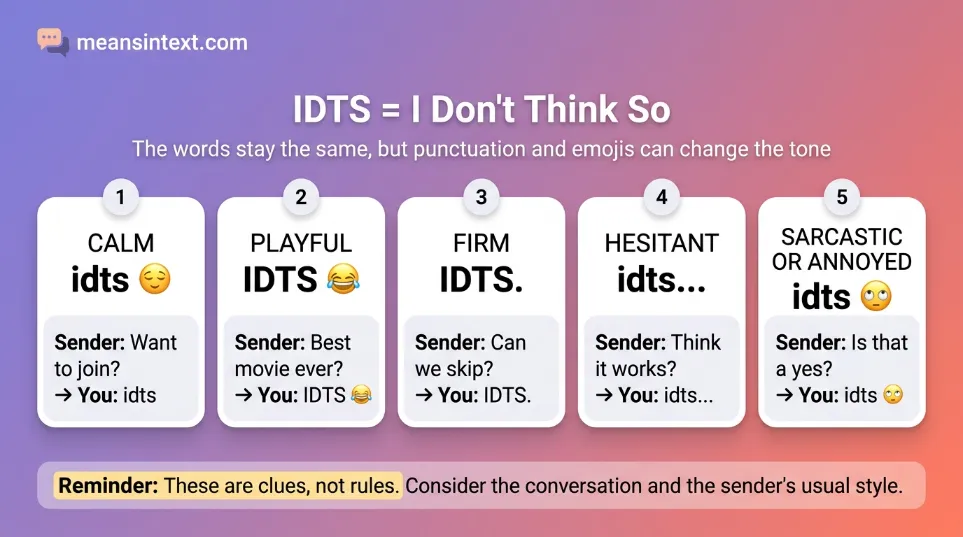
The tone depends on the style:
- Calm: “idts, it closes early” sounds helpful.
- Playful: “IDTS 😂” sounds teasing.
- Sarcastic: “oh sure, idts” can mean “no way.”
- Firm: “IDTS.” with a period can feel final.
Here’s a scene. A friend asks if you’ll go on a long hike this weekend. You’re tired. Texting “no” feels blunt. Texting “idts” says “probably not” and gives them a gentle heads-up. If your friend pushes, you can say “let me think.” That small softness keeps the chat friendly.
Usage in Different Contexts
Friends and casual texting: The most common use. It works for plans, opinions, and quick predictions.
Social media comments: People use it to express doubt about claims, trends, or news.
Group chats: Good for light pushback without a debate.
Romantic chats: Fine for small things. For big topics, a longer message is kinder.
Professional or formal writing: Avoid it. Write “I don’t think that will work” or “I’m not sure that’s possible.”
When NOT to Use It
- At work. Use full sentences, especially in emails.
- When someone shares a hope or dream. A quick “idts” can feel dismissive.
- When you need to give a clear answer. If someone asks a yes-or-no question that really matters, say “no” and explain.
- In an argument. A short reply can feel cold.
- With people who don’t know slang. Spell it out.
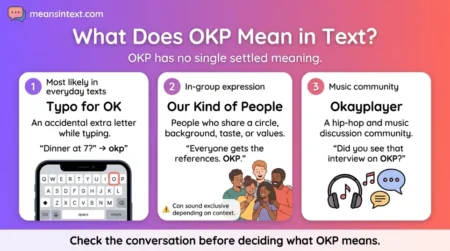
Also Read: What Does OKP Mean in Text: Full Meaning, Origin & Real Examples
Common Misunderstandings
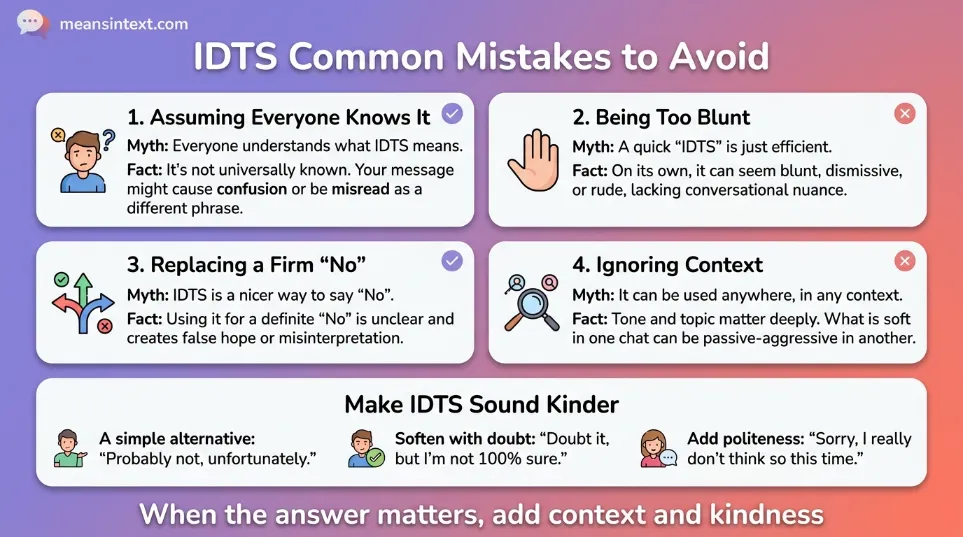
Myth: IDTS means a definite no. Reality: It means “I don’t think so,” which leaves a little room for doubt.
Myth: IDTS always sounds rude. Reality: Tone changes with emojis and context. Many people use it kindly.
Myth: IDTS is the same as IDK. Reality: IDK means “I don’t know.” IDTS means “I don’t think so,” which already leans toward no.
Myth: IDTS has a documented origin date. Reality: The date varies by source and isn’t verified.
Myth: Every definition online is accurate. Reality: Many pages repeat each other. Most agree on the main meaning, but details like “early 2000s” lack support.
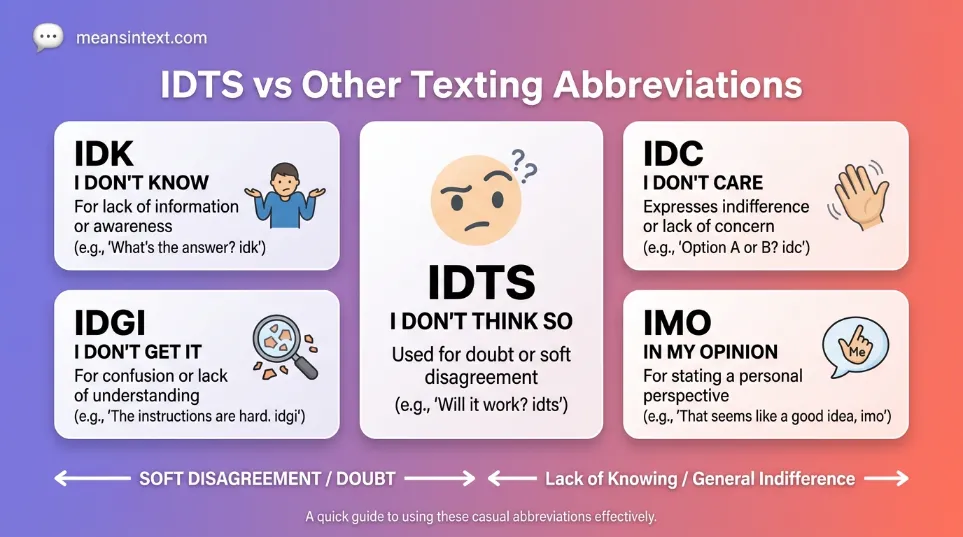
Comparison Table
| Expression | Meaning | Tone | Usage |
|---|---|---|---|
| IDTS | I don’t think so | Soft doubt or polite no | Declining or doubting |
| IDK | I don’t know | Neutral, uncertain | Not having an answer |
| IDC | I don’t care | Dismissive or relaxed | Showing no preference |
| IDGI | I don’t get it | Confused | Asking for explanation |
| IMO | In my opinion | Neutral, personal | Sharing a view |
Key Insight: IDK sits at “unsure,” IDTS sits at “probably not,” and a plain “no” sits at “definitely not.”
Variations / Types
- idts – the casual lowercase form
- IDTS! – stronger emphasis
- idts 😂 – playful, teasing
- idts. – short and firm
- idts maybe – a hedge, “probably not, but we’ll see”
- idts but okay – reluctant agreement
- idts fr – “I don’t think so, for real”
- idts, sorry – a softer decline
How to Respond When Someone Uses It
Casual: “ok, no worries.” Funny: “alright, I’ll take ‘probably not’ as a no.” Mature: “Thanks for letting me know. I’ll adjust the plan.” Respectful: “I understand. Let me know if anything changes.”
If you want more detail:
Clarifying: “Idts as in no, or idts as in maybe?”
The Softness Ladder: From Maybe to No
Different replies signal different levels of doubt or refusal:
| Reply | Level | What it usually means |
|---|---|---|
| maybe | Open | I could go either way |
| idk | Unsure | I don’t have an answer |
| idts | Leaning no | Probably not |
| no | Clear no | I won’t or it isn’t |
| absolutely not | Firm no | There’s no chance |
When you want to be gentle, IDTS sits in a useful middle place. It tells the truth without slamming the door.
How to Tell What IDTS Means in Your Chat
- Look at the question. If it asked about plans, IDTS likely means “probably not.”
- Look at the emoji. A laughing emoji points to teasing.
- Look at the punctuation. A period can sound firm.
- Look at the sender’s style. Do they often use sarcasm?
- Ask if it’s still unclear. One short question settles it.
How to Disagree Politely in Text
Short replies can sound blunt. A few tweaks keep things friendly:
- Add a reason: “idts, I have work tomorrow.”
- Add an alternative: “idts, but how about Saturday?”
- Add thanks: “idts, but thanks for asking.”
- Add warmth: “idts, sorry! Let’s try next time.”
- Use a full sentence for important topics. “I don’t think that will work for me” shows respect.
How Punctuation and Emojis Change the Tone
| Style | Likely tone |
|---|---|
| idts | Calm, matter-of-fact |
| IDTS | A bit louder, more emphatic |
| idts. | Short, possibly firm |
| idts… | Hesitant or doubtful |
| idts 😂 | Playful, teasing |
| idts 😅 | Awkward, apologetic |
| idts 🙄 | Annoyed or sarcastic |
| idts?? | Disbelief, “are you serious?” |
These are habits, not rules. Friend groups develop their own styles. If a message feels off, compare it with how that person usually texts.
IDTS vs. Similar Phrases
| Phrase | How it differs |
|---|---|
| I doubt it | Slightly stronger doubt; sounds more skeptical |
| Not really | Softer, often used for mild disagreement |
| Probably not | The plainest, most neutral version |
| I don’t think so | The full phrase; sounds a bit more formal |
| No | Clear and direct |
IDTS works well when you want to be quick and casual. If the topic matters, the full phrase “I don’t think so” shows more care.
Quick Examples by Situation
- Plans: “Want to go out tonight?” → “idts, I’m wiped.”
- Predictions: “Think it’ll rain?” → “idts, the sky looks clear.”
- Opinions: “Is that movie good?” → “idts, I fell asleep.”
- Requests: “Can you cover my shift?” → “idts, I have plans.”
- Rumors: “He’s quitting, right?” → “idts, he just got promoted.”
Each one answers the question and adds a small reason. That reason keeps the reply from sounding cold.
Soft Refusal Mistakes to Avoid
- Leaving no reason. A bare “idts” can sound dismissive.
- Replying with “idts” to emotional news. Someone sharing a hope may need warmth first.
- Using it for a firm no. If you mean “absolutely not,” say so.
- Overusing it. If every reply is “idts,” people may think you’re negative.
- Ignoring the follow-up. If someone asks “why not?”, answer kindly.
Regional & Cultural Usage
IDTS isn’t tied to a particular region. It appears in English-language chats worldwide, mostly among younger users. The phrase “I don’t think so” is widely understood, so the abbreviation travels well. In cultures where direct refusal feels rude, a softer reply like IDTS can feel more polite than a bare “no.”
Also Read: What Does LFG Mean in Text: Full Meaning, Origin & Real Examples
FAQs
What does IDTS mean in text?
“I don’t think so.”
Is IDTS rude?
Not by itself. The tone depends on context and emojis.
Is IDTS the same as no?
It’s softer. It means “probably not.”
What’s the difference between IDTS and IDK?
IDK means “I don’t know.” IDTS means “I don’t think so.”
Where did IDTS come from?
It’s a shortened form of “I don’t think so.” The exact start date isn’t clear.
Can IDTS be sarcastic?
Yes. A laughing emoji or an exaggerated tone can make it sarcastic.
Should I use IDTS at work?
No. Write a full sentence.
Can I reply to IDTS with “why?”
Yes. Asking “why not?” is a normal follow-up, and most people will explain.
Is IDTS more polite than “no”?
Often, yes. It leaves a little room and sounds less blunt, though the sender’s tone still matters.
Do older people understand IDTS?
Some do, but many don’t use it. If you’re unsure, write “I don’t think so.”
Conclusion
IDTS is a quick, gentle way to say “I don’t think so.” It sits between “maybe” and “no,” which makes it handy for polite disagreement and honest doubt.
When you see it, read the tone and the question it answers. When you use it, add a few words if the topic matters. For more terms explained in plain language, meansintext.com breaks them down one at a time.