

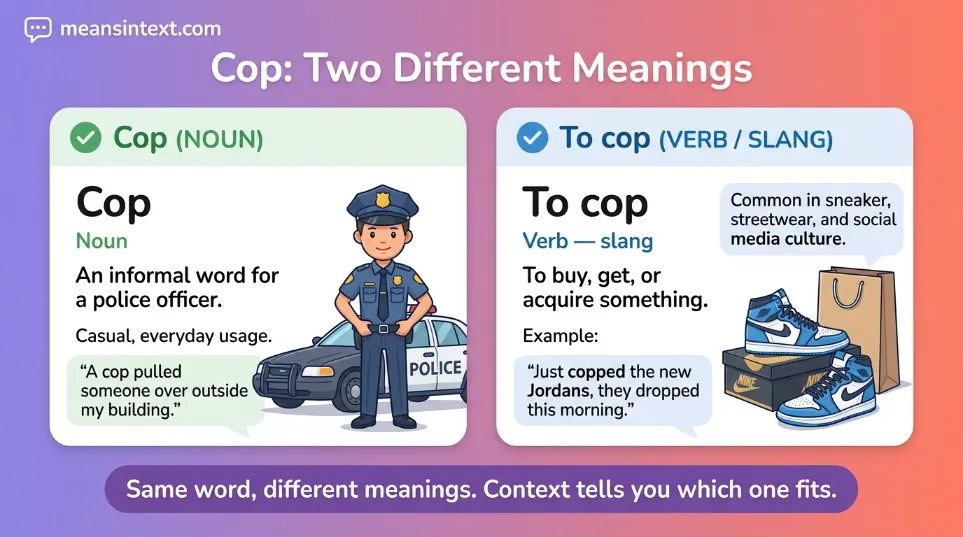
Quick Answer: Cop has two very different meanings in text. As a noun, it's a casual (and sometimes disrespectful) word for a police officer. As slang, especially in sneaker, streetwear, and social media culture, "to cop" something means to buy or acquire it — as in "just copped the new drop."
You saw cop in a text and the meaning probably seemed obvious, until the sentence didn’t quite make sense with “police officer” plugged in. That’s because this word does double duty in modern texting, and the two meanings have nothing to do with each other.
This guide breaks down both real meanings of cop, where the slang version came from, and how to tell which one someone means based on context.
What Does ‘Cop’ Mean – Quick Meaning
Cop has two separate, common meanings:
Simple breakdown:
- As a noun, it’s informal slang for a police officer
- As a verb, “to cop” something means to buy, get, or acquire it
- The verb form is especially common in sneaker culture, streetwear, and social media captions
Example texts:
- “A cop pulled someone over outside my building” (police officer)
- “Just copped the new Jordans, they dropped this morning” (bought/acquired)
- “Cop this before it sells out” (buy this)
Origin & Background
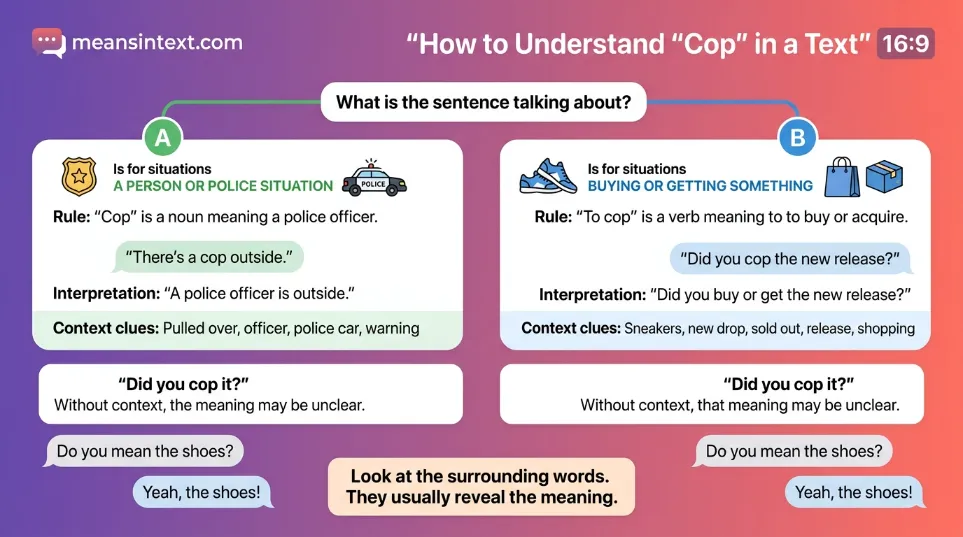
Cop’s two meanings developed along completely separate paths, which is part of why the word can feel confusing out of context.
The police officer meaning
“Cop” as slang for a police officer has been around since at least the 1800s. Language historians generally trace it back to the verb “to cop,” which once meant “to capture” or “to catch” — someone who cops (catches) criminals became known as a “copper,” which eventually shortened to “cop.” This meaning became so common that it’s now considered standard informal English, not really slang anymore in the edgy sense — it shows up in everyday conversation, news headlines, and casual writing without raising an eyebrow.
The “to buy” meaning
The verb meaning — to buy or acquire something — actually comes from that same older root: “to cop” as “to catch” or “to get hold of.” Over time, in street and hip-hop culture, this evolved into a slang term for getting your hands on something, especially something desirable or hard to find. By the 2000s and 2010s, sneaker culture had fully adopted “cop” as its go-to verb for buying a pair of shoes, especially a hyped or limited release. Terms like “cop list,” “must-cop,” and “cook group” (communities built around successfully buying limited drops) all grew out of this usage.
From there, the word spread beyond sneakers into streetwear, beauty, and general online shopping culture. Influencers and brands picked it up as a catchy, energetic call-to-action — “cop this look,” “link in bio to cop,” and similar phrasing became common in captions and ads aimed at younger audiences.
Where it sits today
The police-officer meaning remains extremely common and is understood by virtually everyone, in nearly any English-speaking context. The “to buy” meaning is more culturally specific — it’s especially recognized among people active in sneaker communities, streetwear fans, and younger social media users, but it’s spread widely enough that most people who spend time online will recognize it, even if they’ve never used it themselves.
Real-Life Conversations
1. Text Message (Police Meaning) Person A: there’s a cop parked outside our building again Person B: probably just doing rounds Person A: yeah true, just seemed random
2. Group Chat (Police Meaning) Person A: got pulled over on the way here Person B: oh no, what did the cop say Person A: just a warning, thankfully
3. Text Message (Buying Meaning) Person A: did you cop the new release Person B: yeah, got up early for it Person A: nice, I missed the drop completely
4. Group Chat (Buying Meaning) Person A: these are dropping Friday, who’s copping Person B: I’m in, setting an alarm for it Person C: same, hope the site doesn’t crash this time
5. Instagram Caption (Buying Meaning) “New drop is live. Cop before it’s gone. 🔥”
6. Text Message (Genuinely Ambiguous Without Context) Person A: did you cop it Person B: cop what? the shoes or are we talking about something else Person A: haha the shoes, sorry wasn’t clear
What It Really Means (Emotional & Social Context)
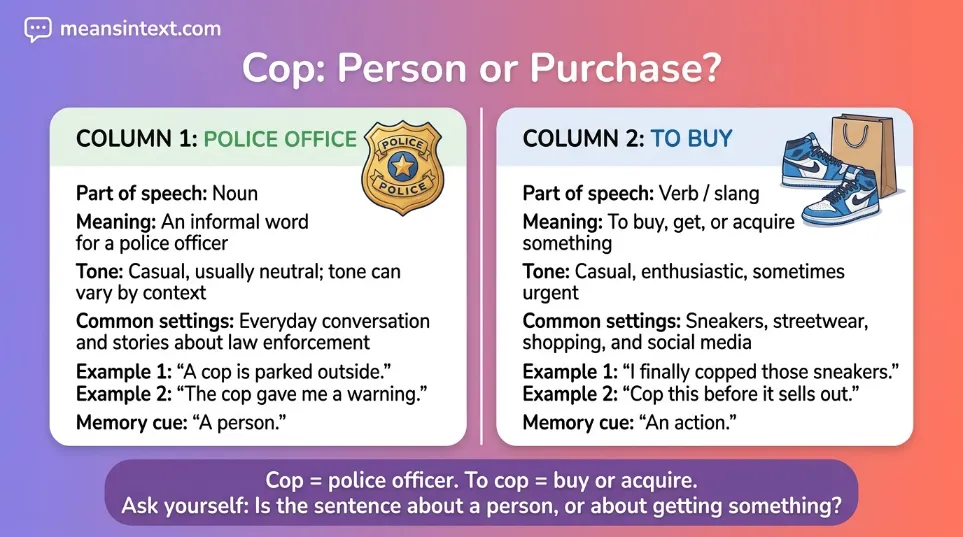
As slang for a police officer, “cop” carries a casual, everyday tone. It’s neutral in most contexts — not particularly respectful or disrespectful, just the common informal word people reach for instead of saying “police officer” every time.
As a verb meaning “to buy,” “cop” carries excitement and urgency. It’s rarely used for boring, routine purchases — nobody says they “copped” a gallon of milk. It’s reserved for things people are genuinely excited about: a hyped sneaker release, a limited drop, a trending product. Using the word signals that the purchase itself is a bit of an achievement, especially when the item is hard to get.
Picture someone texting a friend group the second a limited sneaker release goes live: “IT’S UP, GO COP NOW.” That single word carries urgency, shared excitement, and insider knowledge of the culture around limited drops — a plain “buy it now” wouldn’t hit the same way.
Usage in Different Contexts
Everyday conversation: “Cop” as police officer is completely normal and widely understood, used in casual speech, news, and writing alike.
Sneaker and streetwear communities: “Cop” as “buy” is essential vocabulary, showing up constantly in group chats, forums, and release-day hype.
Social media captions and ads: Brands and influencers use “cop” as an energetic call-to-action, especially aimed at younger audiences.
Professional or formal writing: Neither meaning fits well here — “police officer” is the more appropriate phrasing in formal contexts, and the “buy” slang doesn’t belong in professional writing at all.
When NOT to Use It
- Avoid “cop” as slang for police officer in formal writing, official reports, or professional communication — use “police officer” or “officer” instead
- Don’t assume everyone will understand the “buy” meaning — older audiences or people outside sneaker/streetwear culture may not recognize it
- Be cautious using “cop” around law enforcement themselves in casual conversation, since tone and context matter for how it lands
- Skip the “buy” slang in professional marketing aimed at a broad or older audience, since it may read as confusing rather than catchy
Common Misunderstandings
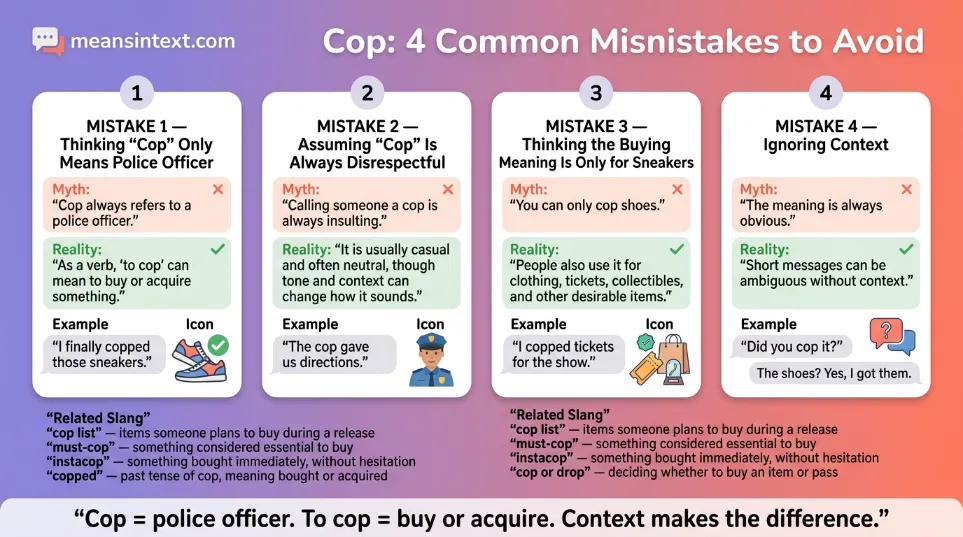
- Myth: Cop only refers to police officers. Reality: In modern slang, especially online, “cop” just as often means to buy or acquire something.
- Myth: The “buy” meaning is brand new internet slang. Reality: It traces back to an older use of “cop” meaning “to catch” or “get hold of,” which has existed for a very long time before sneaker culture picked it up.
- Myth: “Cop” is always disrespectful when referring to police. Reality: It’s typically neutral, casual slang — not inherently negative, though tone and context can shift how it reads.
- Myth: You can only “cop” physical products like sneakers. Reality: People also use it for concert tickets, collectibles, beauty products, and pretty much anything in-demand.
Comparison Table
| Expression | Meaning | Tone | Usage |
| Cop | Police officer / to buy (varies) | Neutral or excited, context-dependent | Everyday conversation, sneaker and shopping culture |
| Snag | To get or grab something, often a deal | Casual, satisfied | General shopping slang |
| Grail | A dream item someone is chasing | Excited, aspirational | Sneaker and collector culture |
| 5-0 | Police, often used as a warning | Alert, cautionary | Slang for spotting police |
Key Insight: “Cop” stands out because its two meanings aren’t just different — they’re a noun and a verb, which is part of why context so quickly clears up any confusion once you know both definitions exist.
Variations / Types
- cop list – a list of items someone plans to buy during a release
- must-cop – describing something considered essential to buy
- instacop – a release so good it gets bought immediately, without hesitation
- cop or drop – deciding whether to buy an item or pass on it
- copped – past tense, confirming a successful purchase (“finally copped these”)
- cop group / cook group – an online community focused on successfully buying limited releases
How to Respond When Someone Uses It
- If it’s about buying something: “Nice, congrats on copping those” or “Let me know if you cop a pair for me too”
- If it’s about police: “Glad it was just a warning” or “Hope everything’s okay”
- Funny (buying context): “You copped those before I even saw the post”
- Respectful (police context): “That sounds stressful, glad it worked out”
Also Read: What Does Lonk Mean in Text: Full Meaning & Real Examples
FAQs
What does cop mean in a text message?
It depends on context — it can mean a police officer, or it can mean to buy or acquire something, especially in sneaker and streetwear culture.
Why do sneakerheads say “cop” instead of “buy”?
It’s part of the specific slang built around sneaker culture, carrying more excitement and insider identity than a plain word like “buy.”
Is “cop” disrespectful when talking about police?
Generally not — it’s casual, everyday slang, though tone and context can shift how it comes across.
Can “cop” be used for things other than sneakers?
Yes, it’s used broadly for anything people are excited to buy, from clothing to tickets to collectibles.
Where does the “buy” meaning of cop come from?
It stems from an older meaning of “cop” as “to catch” or “get hold of,” later adopted by sneaker and streetwear culture as slang for buying.
Is it obvious which meaning someone intends?
Usually yes — context almost always makes it clear whether someone’s talking about a purchase or a police officer.
Conclusion
Cop is a rare case of one short word carrying two completely unrelated modern meanings. As a noun, it’s everyday slang for a police officer. As a verb, it means to buy or acquire something, especially something hyped or limited. Both meanings trace back to the same older root, even though they’ve drifted into very different corners of everyday language.
If you want more terms like this explained clearly, meansintext.com breaks them down one word at a time.