

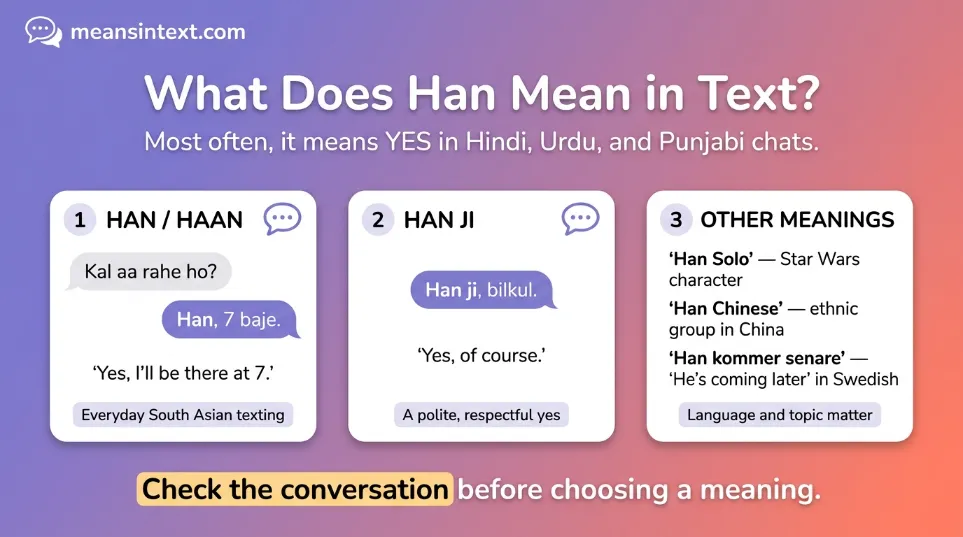
Quick Answer: In text, Han (also spelled haan or haa) most often means "yes" in Hindi, Urdu, and Punjabi chats written in English letters. It's a quick way to agree, confirm, or say "okay." Han can also mean the Han Chinese people, a Korean surname, the Star Wars character Han Solo, or "he" in Swedish, Norwegian, and Danish. The language and topic of the chat tell you which one it is.
You saw Han in a message and your first thought might have been a name. Sometimes it is. But in a lot of chats, especially among South Asian friends and family, it’s a plain “yes.”
This guide explains each meaning, where it comes from, and how to tell which one someone intends. You’ll also get real chat examples, polite replies, and a few mistakes to avoid.
What Does ‘Han’ Mean – Quick Meaning
Han means “yes” in Hindi and Urdu, written in the English alphabet.
Simple breakdown:
- Main texting meaning: “yes,” “okay,” or “I agree” in Hindi, Urdu, and Punjabi chats
- Spellings: han, haan, haa, haan ji
- Other meanings: Han Chinese people, the Korean surname Han, Han Solo from Star Wars, and “he” in Scandinavian languages
Example messages:
- “Han, I’ll be there at 6.” (Yes)
- “Han ji, bilkul.” (Yes, of course.)
- “Han? Kya kaha?” (Huh? What did you say?)
- “Han Solo is my favorite character.” (Star Wars)
Origin & Background
Each meaning of Han has its own history. They share spelling by coincidence.
Why the meaning varies so much
Han is a short word. Many languages have short words. That’s why the same letters turn up in South Asia, East Asia, Scandinavia, and film fandom, each with a different job.
The Hindi and Urdu meaning: “yes”
In Urdu and Hindi, the word for “yes” is written ہاں in Urdu script and हाँ in Devanagari. When people text in English letters, they spell it han, haan, or haa. This style is often called Roman Urdu or Hinglish. The Rekhta Urdu dictionary lists the word as “yes,” “yes, certainly,” and “say yes, assent, agree, accept.”
The word also appears in set phrases. Rekhta notes haan to is used to pick up a conversation again after an interruption. It also lists han han ke, an idiom for agreeing with whatever someone says. The pair haan-naa means “yes or no,” a direct answer.
Han Chinese and the Han dynasty
Han is the name of the largest ethnic group in China. It comes from the Han dynasty, which ruled from 206 BCE to 220 CE. People still refer to “Han Chinese” in history, language, and population talk. This meaning shows up in news, school, and culture chats, not in casual texting.
The Korean surname and “han” the feeling
Han (한) is also a common Korean family name. In a separate sense, Korean culture uses han for a deep, complex feeling of sorrow and resilience. People mention it when discussing Korean art, music, and film.
Han Solo
In Star Wars, Han Solo is the smuggler and pilot played by Harrison Ford in the original films. Fans sometimes just say “Han.” If the chat is about movies, space, or quotes, it’s probably him.
“He” in Scandinavian languages
In Swedish, Norwegian, and Danish, han means “he.” You’ll see it in chats among speakers of those languages. A line like “Han kommer senare” means “He’s coming later.”
Reading the sourcing honestly
The Hindi and Urdu meaning is confirmed in a standard dictionary. The other meanings are well-known facts from history, culture, film, and language. Many weak websites guess at texting definitions without sources, so check the chat itself.
Where it sits today
The “yes” meaning is part of everyday speech and texting for hundreds of millions of people. Han Solo and Han Chinese stay common in their own topics. The Scandinavian meaning is steady in those languages.
Real-Life Conversations
1. WhatsApp (Roman Urdu: Yes) Person A: Kal shaam ko aa rahe ho? Person B: Han, 7 baje tak pohanch jaunga Person A: Theek hai, intezar karungi
(Translation: “Are you coming tomorrow evening?” “Yes, I’ll arrive by 7.” “Okay, I’ll wait.”)
2. Family Group Chat (Polite Yes) Person A: Abbu ne kaha khana ready hai Person B: Han ji, aa rahi hoon Person A: Jaldi karo
(Translation: “Dad says food is ready.” “Yes, I’m coming.” “Hurry.”)
3. Text Message (Huh?) Person A: Meeting ka time change ho gaya Person B: Han? Kab ka? Person A: Subah 10 baje
(Translation: “The meeting time changed.” “Huh? To when?” “10 in the morning.”)
4. Instagram DMs (Agreeing) Person A: Yeh gaana toh kamaal hai Person B: Han han, bilkul [INTERNAL LINK: what does hmu mean in text] Person A: Repeat pe lagaya hua hai
(Translation: “This song is amazing.” “Yes yes, totally.” “I have it on repeat.”)
5. Group Chat (Star Wars) Person A: Who’s your favorite character? Person B: Han, easily. The sarcasm is perfect. Person A: Same, and Chewbacca
6. Chat in Swedish Person A: Var är Erik? Person B: Han kommer senare Person A: Okej, vi väntar
(Translation: “Where is Erik?” “He’s coming later.” “Okay, we’ll wait.”)
7. Text Message (Unclear) Person A: han Person B: han as in yes, or are we talking about the movie? Person A: lol yes, sorry
What It Really Means (Emotional & Social Context)
Each meaning has a different feel.
“Yes” (Hindi/Urdu): The tone depends on how it’s said. A quick “han” is casual agreement. “Han ji” is polite and respectful, often used with elders. “Han han” can show enthusiasm, or it can show impatience, like “yes, yes, I heard you.” A rising “han?” works like “huh?” and asks someone to repeat.
Han Chinese: The tone is factual and cultural.
Korean surname or “han”: The tone is personal or reflective.
Han Solo: The tone is playful and fan-focused.
Scandinavian “he”: The tone is neutral and practical.
Here’s a scene. A mother texts her son: “Khana kha liya?” (“Did you eat?”). He replies “Han.” That one word answers, calms her, and ends the check-in. Now picture the same word in a movie group chat. It points to a smuggler with a blaster. The spelling is the same. The setting changes everything.
Also read: What Does WSS Mean in Text: Full Meaning, Origin & Real Examples
Usage in Different Contexts
Friends and family chats in South Asia and the diaspora: Han is a normal, quick yes. It fits informal talk.
Respectful replies: Han ji works for elders, teachers, and in polite work messages.
Social media comments: People use han to agree or to ask “huh?”
Movie and fandom chats: Han refers to Han Solo.
Scandinavian chats: Han means “he.”
Professional or formal writing: Write “yes” in English, or use proper Urdu or Hindi script if that’s your audience. Keep Roman Urdu for casual messages.
When NOT to Use It
- With people who don’t speak Hindi or Urdu. They may not recognize it as “yes” and could read it as a name.
- In formal emails. Write “Yes” or “Certainly.”
- With elders, if you skip the respect marker. A bare “han” can sound curt. “Han ji” is safer.
- When you mean “no.” Don’t mix it up with “nahi.” A rushed reply can cause confusion.
- When the topic is mixed. If a chat blends Hindi and English talk with movie talk, add context.
Common Misunderstandings
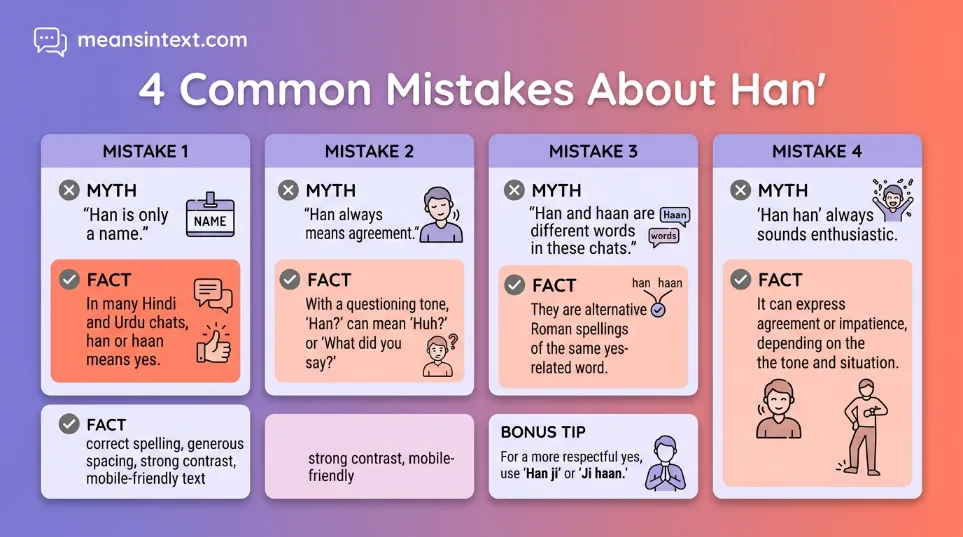
Myth: Han is only a name. Reality: In many chats it means “yes.”
Myth: Han and “hun” are the same. Reality: “Hun” is a different word, often a pet name. Han in this sense is “yes.”
Myth: Han always means agreement. Reality: With a rising tone, “han?” can mean “huh?” or “what?”
Myth: Roman Urdu has one fixed spelling. Reality: People spell it han, haan, or haa. All mean the same.
Myth: “Han han” always shows enthusiasm. Reality: It can show impatience or brushing off, depending on tone.
Comparison Table
| Expression | Meaning | Tone | Usage |
| Han / Haan | Yes | Casual, direct | Quick agreement in Hindi/Urdu chats |
| Ji | Respectful “yes” or acknowledgement | Polite | Talking with elders or in formal settings |
| Nahi | No | Direct | Refusing or disagreeing |
| Acha | Okay / I see / good | Neutral, friendly | Acknowledging information |
| Theek hai | Okay, fine | Calm, accepting | Agreeing to plans |
Key Insight: Han is the core “yes,” while ji adds respect and acha shows you understood. Together they cover most daily agreement in these chats.
Variations / Types
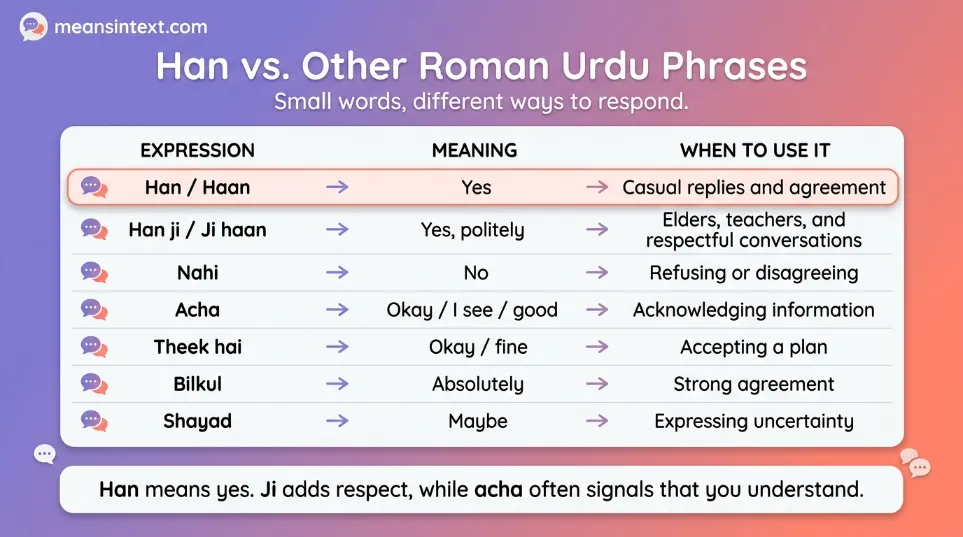
- han – the quick, common spelling
- haan – a slightly stretched version
- haa – an even shorter casual form
- han ji – a polite yes
- han han – repeated for emphasis or impatience
- han bhai – casual yes to a friend or brother
- haan to – used to resume a conversation after a break
- han? – a questioning “huh?”
How to Respond When Someone Uses It
If it’s a “yes” to your question:
Casual: “Theek hai, shukriya.” (Okay, thanks.) Short: “Great, see you then.” Polite: “Bohot shukriya.” (Thank you very much.)
If it’s “han?” meaning huh:
Helpful: Repeat or clarify your message.
If it’s about Han Solo:
Casual: “Han shot first. Fight me.”
If it’s the Scandinavian “he”:
Casual: “Okay, I’ll wait for him.”
If you’re not sure:
Clarifying: “Do you mean yes, or the character?”
Quick Phrase Guide: Saying Yes in Roman Urdu and Hinglish
If you’re learning how these chats work, these common phrases show the range of “yes” and its neighbors.
| Phrase | Meaning | When to use it |
| han / haan | Yes | Casual replies |
| han ji / ji haan | Yes (polite) | Elders, teachers, work |
| bilkul | Absolutely | Strong agreement |
| theek hai | Okay | Accepting a plan |
| shayad | Maybe | Not sure yet |
| nahi | No | Refusing |
A few tips help you read these chats. First, tone is often carried by punctuation and repeated letters, so “haaan” can sound lazy or playful. Second, “han” followed by a question mark usually asks for a repeat. Third, many messages mix English and home-language words in one line. That’s normal code-switching. Fourth, spelling varies from person to person, so don’t treat a different spelling as a different word.
How to Tell Which Han You’re Looking At
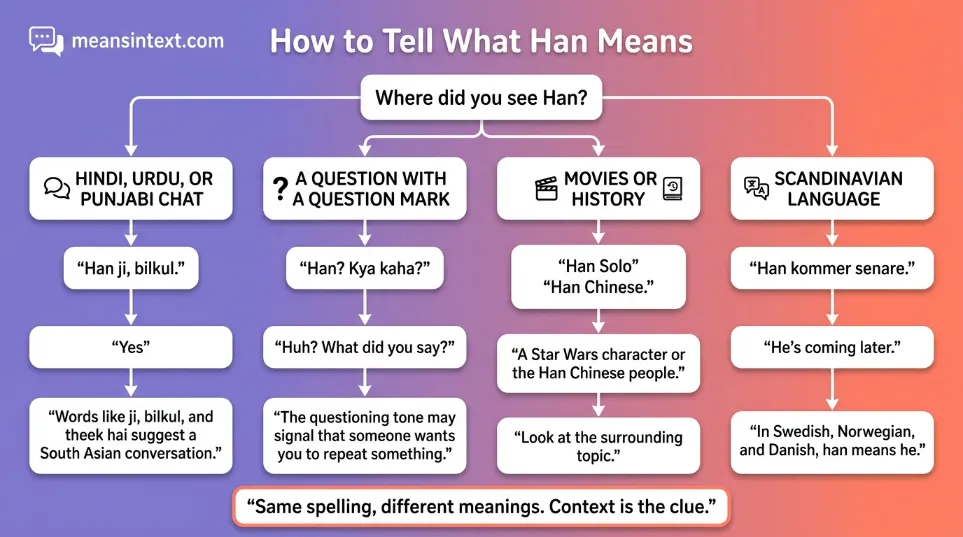
- Check the language around it. Words like “ji,” “bilkul,” or “theek hai” point to Hindi or Urdu.
- Check the topic. Movies, Harrison Ford, or the Millennium Falcon point to Han Solo.
- Check the capital letter. A capital H in a sentence about people or history may be a name or the Han Chinese.
- Check the punctuation. “Han?” with a question mark often means “huh?”
- Ask if it’s still unclear. A short question is better than a wrong guess.
Regional & Cultural Usage
The “yes” meaning is strongest in Pakistan, India, and South Asian communities abroad. It sits across Hindi, Urdu, and Punjabi speech. In English-speaking chats, it shows up in code-switching, where people mix English and their home language. The Scandinavian meaning stays in Sweden, Norway, and Denmark. Han Chinese and the Han dynasty appear in global history and culture talk. The Korean surname is common in Korea and the diaspora.
Also Read: What Does YN Mean in Text: Full Meaning, Origin & Real Examples
FAQs
What does han mean in text?
Most often it means “yes” in Hindi and Urdu chats written in English letters.
What is the difference between han and haan?
Nothing. They’re two spellings of the same word.
What does han ji mean?
It means a respectful “yes.”
Can han mean “huh”?
Yes. With a rising tone, “han?” can mean “what?” or “huh?”
What does han han mean?
It can mean “yes, yes” in agreement or in impatience.
Does han mean something in Swedish?
Yes. It means “he.”
Is Han a name?
Yes. It can be a Korean surname or the name of Han Solo.
Conclusion
Han is a short word with several jobs. In many South Asian chats, it simply means “yes.” In other settings, it can point to a people, a surname, a film hero, or the word “he.”
When you see it, check the language and topic. A family chat, a Star Wars thread, and a Swedish group each use it differently. For more terms explained in plain language, meansintext.com breaks them down one at a time.