

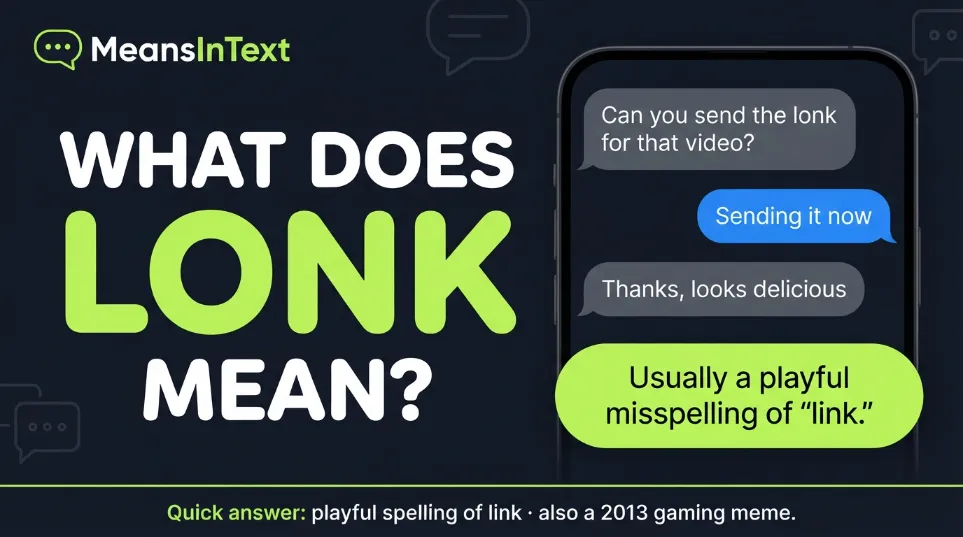
You saw lonk in a text or comment, and it looks like someone just misspelled “link.” Most of the time, that’s exactly what’s happening, and it’s usually on purpose. The word also has a deeper meme history tied to gaming culture, dating back over a decade.
This guide breaks down what lonk means today, where the word originally came from, and how it’s used in casual texting and comment sections. You’ll see real examples and clear guidance either way.
What Does ‘Lonk’ Mean – Quick Meaning
Lonk is most commonly a playful, intentional misspelling of “link,” used when asking for or sharing a URL. It also references “Lonk from Pennsylvania,” a long-running internet meme based on the character Link from The Legend of Zelda.
Simple breakdown:
- Most often a meme-style, funny way of typing “link”
- Used casually when sharing or requesting a URL
- Also references an older, specific internet meme involving a corrupted Nintendo Mii character
Example messages:
- “Can you send the lonk for that video?”
- “Here’s the lonk to the article I mentioned.”
- “Lonk in bio, check it out.”
Origin & Background
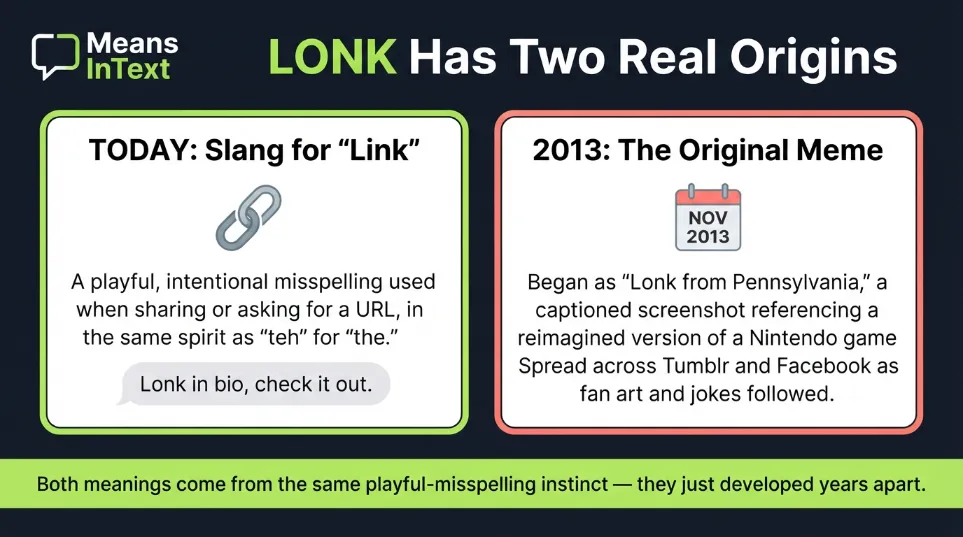
Lonk actually has two separate points of origin, both rooted in internet meme culture, though they developed years apart.
The original meme
The earliest known use of “Lonk” traces back to November 2013, when a screenshot of a Nintendo Mii character dressed as Link from The Legend of Zelda was posted online, captioned as “Lonk from Pennsylvania.” The image spread across platforms like Tumblr and Facebook, and fans began creating their own art and jokes based on this corrupted version of the character, similar to how “Sanic” became a distorted version of Sonic the Hedgehog. This meme treated “Lonk” as an alternate, slightly off version of the beloved Zelda hero.
The newer, broader slang meaning
Separately, and more recently, lonk developed into general internet slang simply meaning “link,” following a pattern common in meme culture where words get intentionally misspelled for comedic or ironic effect. Similar to how “the” becomes “teh” or “because” becomes “bc,” typing “lonk” instead of “link” adds a light, playful tone to an otherwise plain request.
How the two meanings connect
While the original Zelda meme and the newer “link” slang share the same word, they developed somewhat independently. The playful misspelling habit common across meme culture likely made “lonk” feel like a natural, funny stand-in for “link” regardless of its earlier association with the Zelda meme.
Where it sits today
The “link” meaning is by far the more common use in everyday texting and comment sections today, especially on platforms like TikTok, Discord, and Reddit. The original Zelda meme still gets referenced occasionally by longtime fans of that specific joke, but it’s less central to how most people encounter the word now.
Why the newer meaning overtook the older one
The “link” slang usage spread more broadly because it solves a common, everyday texting need, while the Zelda meme stayed tied to a specific fandom and moment in internet history. Broad, practical slang tends to outlast niche character-based memes simply because more people have a reason to use it.
Real-Life Conversations
1. Text Message Person A: Can you send the lonk for that recipe? Person B: Sending it now Person A: Thanks, looks delicious
2. Discord Person A: Anyone have the lonk to the new patch notes? Person B: Posting it in the announcements channel Person A: Perfect, thanks
3. TikTok Comments User1: Where’s this song from User2: Lonk in my bio User3: [INTERNAL LINK: related slang term] thank you so much
4. Reddit Comment User1: This deal looks great, got a lonk? User2: Here you go, still active as of today User1: Appreciate it
5. Gaming Chat (Zelda Meme Reference) Person A: Just started my Breath of the Wild replay Person B: Lonk from Pennsylvania rides again Person A: Every single time, never gets old
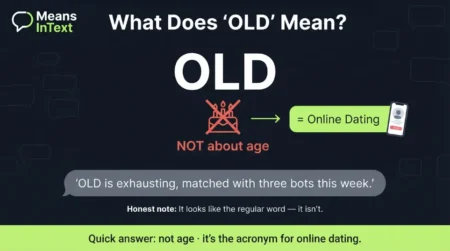
Also Read: What Does OLD Mean in Text? Full Meaning & Real Examples
What It Really Means (Emotional & Social Context)
As slang for “link,” lonk carries a light, joking tone. It’s not really about the misspelling itself meaning anything different — it’s about signaling a casual, meme-literate way of communicating rather than a plain, formal request.
People reach for it because it fits naturally into spaces where playful, intentionally “wrong” spelling is already the norm, like gaming Discords, comment sections, and meme-heavy group chats.
Picture someone asking for a link in a casual group chat. Typing “got a lonk?” instead of “do you have the link?” signals a relaxed, in-on-the-joke tone, fitting the same energy as the rest of the conversation.
Usage in Different Contexts
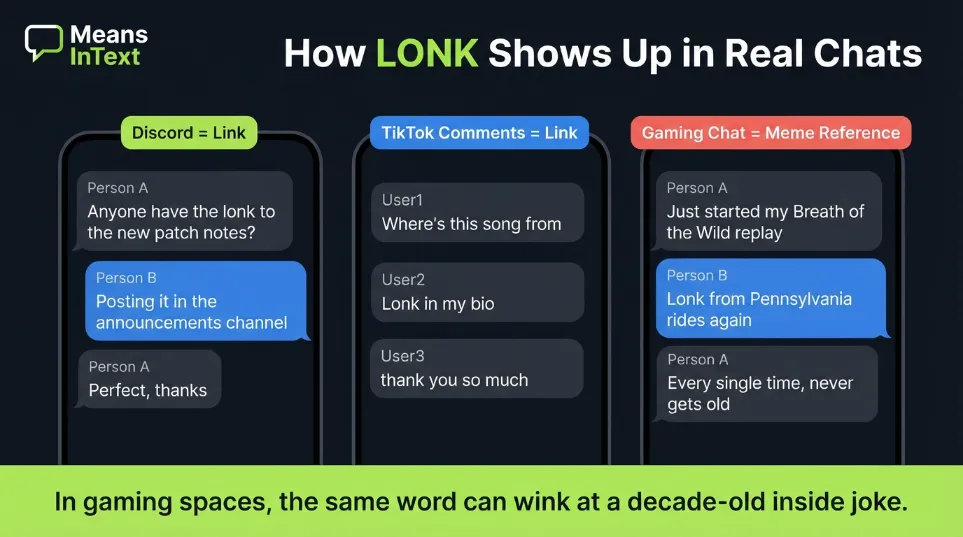
On gaming platforms and Discord, lonk shows up constantly as a casual stand-in for “link,” especially among communities already comfortable with meme-style spelling.
On TikTok and Instagram, it’s common in comments asking for a link to a product, song, or video, often replied to with “lonk in bio.”
Among longtime gaming or Zelda fans, it can also specifically reference the “Lonk from Pennsylvania” meme, especially in conversations about the Zelda franchise.
In professional settings, avoid it. The intentional misspelling reads as too casual and meme-driven for work communication.
When NOT to Use It
Lonk works well in casual, meme-friendly spaces, but a few situations call for the standard spelling instead.
- Avoid it in professional or formal writing, where “link” reads more clearly
- Be mindful using it with anyone unfamiliar with meme culture, since it may just look like a typo
- Skip it in situations where clarity matters most, like sharing important documents or instructions
- Use “link” instead if there’s a real risk the misspelling could be mistaken for an actual mistake rather than an intentional joke
Common Misunderstandings
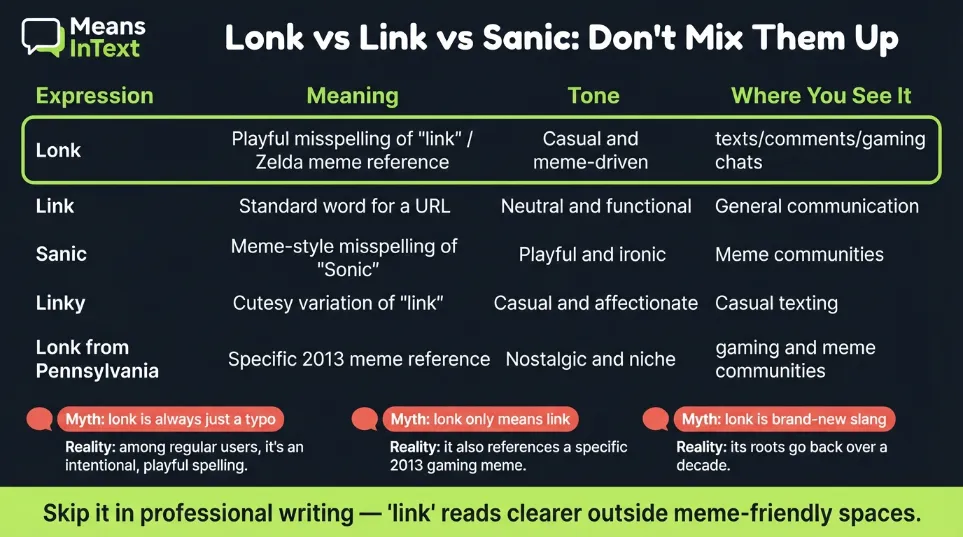
Myth: Lonk is always just a typo. Reality: Among people who use it intentionally, it’s a deliberate, playful stand-in for “link.”
Myth: Lonk only means “link.” Reality: It also has a separate, well-documented meme history tied to a corrupted version of Link from The Legend of Zelda, dating back to 2013.
Myth: Lonk is brand-new slang. Reality: Its roots as an internet meme go back over a decade, even though the “link” slang usage has become more common more recently.
Myth: Everyone recognizes lonk the same way. Reality: Some people know it only as meme-style slang for “link,” while others associate it specifically with the older Zelda meme, and some don’t recognize it at all.
Comparison Table
| Expression | Meaning | Tone | Usage |
| Lonk | Playful misspelling of “link” / Zelda meme reference | Casual, meme-driven | Texts, comments, gaming chats |
| Link | Standard word for a URL | Neutral, functional | General communication |
| Sanic | Meme-style misspelling of “Sonic” | Playful, ironic | Meme communities |
| Linky | Cutesy variation of “link” | Casual, affectionate | Casual texting |
| Lonk from Pennsylvania | Specific meme referencing a corrupted Zelda character | Nostalgic, niche | Gaming and meme communities |
Key Insight: Lonk stands out because it carries two distinct, genuinely documented histories — a specific character-based meme and a broader, newer slang habit — both rooted in the same instinct for playful misspelling.
Variations / Types
- got a lonk? – Casual way of asking for a link
- lonk in bio – Common phrase directing someone to a link in a profile
- send the lonk – Direct request for a URL
- lonk pls – Adds politeness to the request
- Lonk from Pennsylvania – Specific reference to the original 2013 Zelda meme
How to Respond When Someone Uses It
Casual: “Sending the lonk now!” Funny: “Lonk secured ” Mature: “Here’s the link, let me know if it works.” Respectful: “Happy to share, one sec.”
Regional & Cultural Usage
Lonk as general slang for “link” leans younger, most common among Gen Z and younger Millennials active in meme-heavy online spaces like Discord, TikTok, and Reddit. The original Zelda meme skews toward people who were active in gaming and meme communities around 2013 and 2014, when it first spread.
There’s no strong regional split tied to country or language, since both the meme and the slang usage spread through global internet platforms rather than any local community.
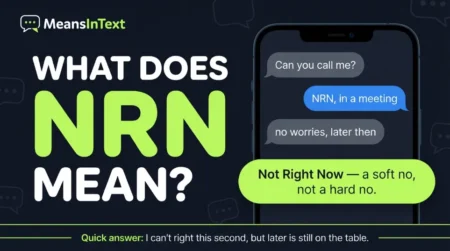
Also Read: What Does NRN Mean in Text: Full Meaning & Real Examples
FAQs
What does lonk mean in a text message?
It’s most often a playful, intentional misspelling of “link,” used when sharing or requesting a URL.
Where did lonk originally come from?
It traces back to a 2013 meme called “Lonk from Pennsylvania,” based on a Nintendo Mii character dressed as Link from The Legend of Zelda.
Is lonk just a typo?
Usually not, among people who use it on purpose. It’s typically intentional, playful spelling.
Is lonk appropriate for professional messages?
No, it’s too casual and meme-driven for work communication.
Is lonk common slang?
Yes, especially in gaming communities, Discord servers, and meme-heavy comment sections.
Does lonk always reference the Zelda meme?
Not necessarily. Most everyday uses simply mean “link,” though the Zelda meme reference still shows up among longtime fans of that specific joke.
Conclusion
Lonk carries two real histories behind it — a specific, well-documented meme from 2013 involving a corrupted version of Link from The Legend of Zelda, and a broader, more recent habit of playfully misspelling “link” in casual online spaces. Context usually makes clear which one someone means, though most everyday uses simply point to a URL.
Next time you see it, you’ll know exactly what’s being asked. And if you want more terms explained the same clear way, meansintext.com breaks them down one text at a time.