

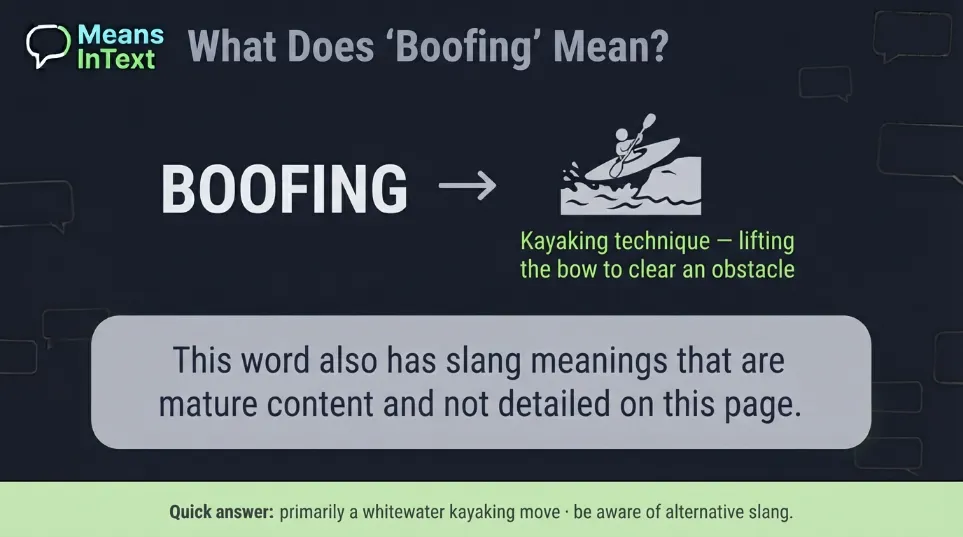
Quick Answer: Boofing has more than one meaning. In whitewater kayaking, it's a technique for clearing an obstacle by lifting the bow of the boat. As slang, it's a crude term that can refer to anal sex or to the risky, unsafe practice of putting alcohol or drugs into the body rectally. The word became widely known in 2018 during a U.S. Senate confirmation hearing, which is why so many people searched it for the first time.
You probably saw boofing somewhere online, a comment, a meme, a news headline, and had no idea what it meant. That confusion is completely normal. This word means very different things depending on where you encounter it, and one of those meanings is genuinely mature content.
This guide explains all the real meanings behind boofing, where the word came from, and how to read it responsibly depending on the context you found it in.
What Does ‘Boofing’ Mean – Quick Meaning
Boofing has three main uses, and they’re unrelated to each other:
Simple breakdown:
- In kayaking, it’s a technique for lifting the front of a kayak to avoid getting stuck on rocks or ledges
- As crude slang, it can refer to anal sex
- It’s also slang for the unsafe practice of putting alcohol or drugs into the body rectally
Example uses:
- “You need to boof that ledge or you’ll flip” (kayaking)
- A 2018 news headline referencing “boofing” during a Senate hearing (slang, discussed below)
- Someone describing a kayaking trip: “Boofed that drop perfectly today”
Because two of these meanings are mature, this guide covers them factually and briefly, without going into graphic or instructional detail.
Origin & Background
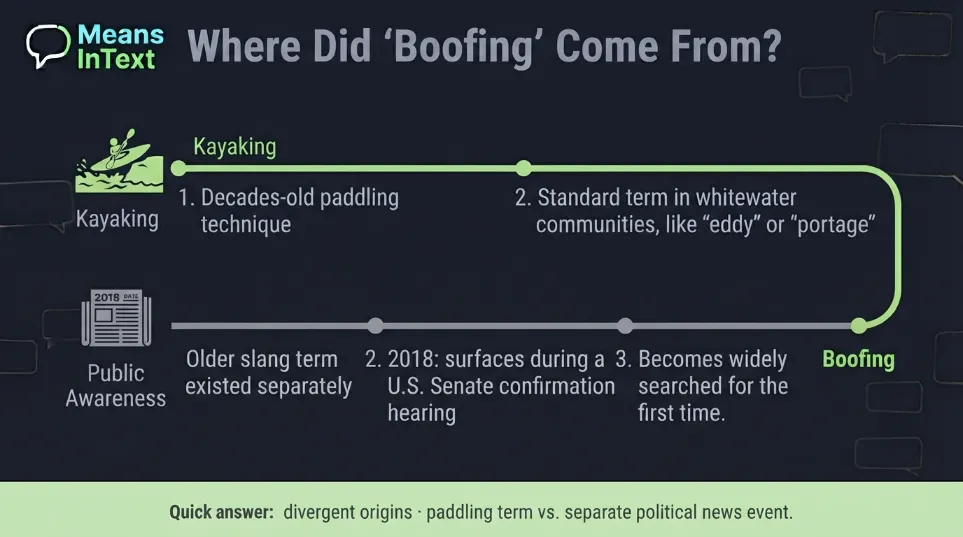
Boofing’s history is genuinely split between two separate worlds: outdoor sports and crude internet slang.
The kayaking meaning
Among whitewater paddlers, “boof” describes a specific paddling move. It’s used to clear a rock, ledge, or hole by lifting the kayak’s bow at the right moment, keeping the boat from diving underwater. This use has existed in kayaking communities for decades and is completely unrelated to the slang meanings. It’s considered a normal, technical term within the sport, similar to “eddy” or “portage.”
The slang meaning
The crude slang version traces back further than most people realize. Language researchers have linked it to a shortened form of a much cruder phrase from decades ago, with earlier documented appearances in prison slang describing hiding items in the body, and later in casual slang describing anal sex.
By the 2000s, the word had picked up another meaning in some party and drug subcultures: putting alcohol or drugs into the body rectally. This is a real but obscure practice, referenced occasionally in slang dictionaries and firsthand accounts from certain scenes. It is not something this article will explain further, since doing so would cross into unsafe territory — but it’s worth knowing the term exists so you understand why some sources treat this word as sensitive.
How it went mainstream
Boofing became a household word almost overnight in 2018, when it surfaced during a U.S. Senate confirmation hearing after appearing in a decades-old yearbook entry. The term’s ambiguous, multi-meaning history became a major talking point in the news cycle, with competing explanations offered publicly. That moment is largely why so many people encountered the word for the first time and went looking for a clear definition.
Also Read: What Does BIM Mean in Text: Full Meaning & Real Examples
Where it sits today
Outside of kayaking circles, boofing mostly shows up as a punchline or a reference to that 2018 news moment, rather than in everyday serious use. Its slang meanings are still around in certain online spaces, but they’re not common in mainstream texting the way most terms on this site are.
Real-Life Conversations
Because two of this word’s meanings are inappropriate for casual chat, the examples below focus on the kayaking meaning and on people encountering the term for the first time — not on the crude slang usage.
Text Message (Kayaking) Person A: that rapid has a nasty hole at the bottom Person B: yeah you gotta boof it hard or you’ll get stuck Person A: noted, thanks for the warning
Group Chat (Kayaking) Person A: anyone want to run the river Saturday Person B: only if we practice boofing first, that ledge scared me last time Person C: fair, let’s warm up on the smaller drops
Text Message (Confused by the Word) Person A: why is “boofing” trending Person B: it’s from a news story a while back, has like three different meanings Person A: oh no, I looked it up and regretted it
Text Message (Clarifying Context) Person A: my kayaking instructor kept saying “boof” and I had no idea what she meant Person B: [INTERNAL LINK: what does wyo mean in text] lol it’s a real paddling term, don’t worry
What It Really Means (Emotional & Social Context)
The kayaking meaning carries no baggage at all — it’s just technical shorthand within a sport, the same way skiers say “carve” or climbers say “beta.” Paddlers use it constantly and neutrally.
The slang meanings are different. They tend to show up as shock value, dark humor, or a way to reference the 2018 news controversy rather than as sincere, everyday usage. Because the word’s crude history is genuinely part of its meaning, hearing it used casually by someone unfamiliar with kayaking usually signals they’re referencing the slang, not the sport.
Usage in Different Contexts
Kayaking and outdoor sports: Completely normal, technical, and neutral.
Social media and comment sections: Often used as a punchline referencing its complicated public history, rather than its literal slang meaning.
Casual texting: Rare outside of paddling circles; if it comes up, context usually makes clear which meaning is intended.
Professional or formal settings: Avoid entirely — none of this word’s meanings belong in that kind of conversation.
When NOT to Use It
- Never use the slang meanings around people you don’t know well — they can come across as vulgar or offensive
- Avoid it in mixed-age settings unless you’re specifically discussing the kayaking technique
- Don’t use it assuming everyone will read it the “clean” way — plenty of people will only know the crude meaning
- Skip it in professional writing, resumes, or anything formal, regardless of which meaning you intend
Common Misunderstandings
Myth: Boofing only has one meaning. Reality: It has at least three distinct meanings across kayaking and slang, which is unusually split even for ambiguous internet terms.
Myth: The word was invented in 2018. Reality: Both the kayaking term and the crude slang predate that year by decades; 2018 is simply when it became widely searched.
Myth: It’s always about the mature slang meaning. Reality: Among paddlers, it’s an everyday, completely neutral technical term.
Myth: Everyone online uses it the same way. Reality: Context matters enormously here — a kayaking forum and a random online comment section can mean two totally different things by the same word.
Comparison Table
| Expression | Meaning | Tone | Usage |
| Boofing (kayaking) | A technique to clear obstacles in whitewater | Neutral, technical | Paddling instruction and trip talk |
| Eddy | A calm spot behind an obstacle in a river | Neutral, technical | Kayaking and rafting |
| Portage | Carrying a boat around an obstacle on land | Neutral, technical | Kayaking and canoeing |
| Send it | To commit fully to a difficult move | Casual, enthusiastic | Outdoor sports slang generally |
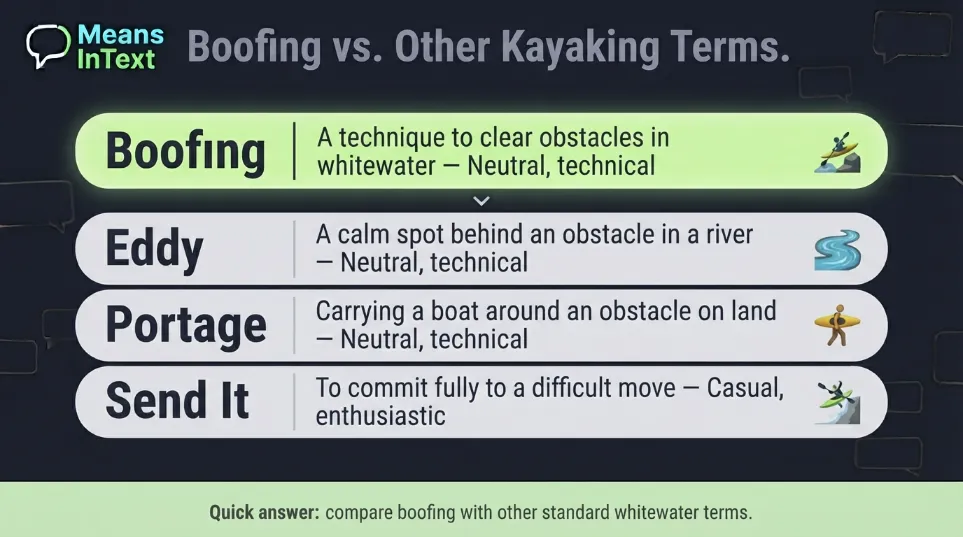
Key Insight: Within kayaking, “boofing” sits alongside plenty of other neutral technical terms — it’s only outside that world that the word carries a very different, more complicated reputation.
Variations / Types
- boof stroke – the specific paddle stroke used to execute the kayaking move
- boof it – shorthand instruction to a paddler approaching an obstacle
- clean boof – a well-executed version of the kayaking maneuver
- boofed – past tense, used to describe a completed move (“I boofed that ledge perfectly”)
Because the slang meanings of this word are mature and not appropriate to detail further, this list focuses only on kayaking-related variations.
How to Respond When Someone Uses It
If it’s clearly about kayaking: “Nice, did you clear the hole okay?”
If someone brings up the word out of confusion: “Yeah, it’s one of those words with a few totally different meanings — depends who’s using it.”
Its usage as if someone uses the slang meaning inappropriately: It’s fine to simply not engage, or to redirect the conversation — you’re not obligated to respond to crude language.
Is It Safe for Kids?
No — at least two of this word’s meanings are not appropriate for children, and the word is worth being aware of if you’re a parent monitoring what your kids encounter online.
The kayaking meaning is completely fine and often taught to young paddlers in supervised lessons. But because the crude slang meanings are easy to stumble across through a simple search, it’s worth knowing this term exists if digital literacy or online safety comes up in a conversation with a child or teen. If a young person mentions hearing this word, it’s a reasonable moment to ask where they saw it and talk through what’s appropriate to search or repeat online.
Also Read: What Does WYLA Mean in Text? Full Meaning & Real Examples
FAQs
Is boofing a bad word?
It depends entirely on context — in kayaking, it’s a completely normal technical term. As slang, it can be crude or inappropriate.
Why did boofing become famous in 2018?
It surfaced during a high-profile U.S. Senate confirmation hearing after appearing in an old yearbook, and its ambiguous meaning became part of the news coverage.
Is boofing dangerous?
The kayaking technique, done properly and with training, is a standard part of the sport. The slang practice of putting substances into the body rectally is unsafe and carries serious health risks, which is part of why it isn’t detailed further here.
Can I use “boof” casually with friends?
Only if you’re confident they’ll understand it as the kayaking term — otherwise, it’s likely to be read as crude slang.
Is there a clean way to explain what boofing means?
Yes, sticking to the kayaking definition is the safest, most universally understood explanation if you need to define the word for a general audience.
Why does this word have so many unrelated meanings?
It’s largely a coincidence of language — a sports term and a piece of crude slang happened to land on the same word independently.
Conclusion
Boofing is an unusual case: a completely normal technical term in one community, and mature slang in another, with almost no overlap between the two. If you’re hearing it from a paddler, it’s simply describing a kayaking move. If you’re seeing it referenced online in a joking or shocked tone, it’s almost certainly pointing back to its crude slang meaning or its brief moment in the news.
For more terms explained clearly and responsibly, meansintext.com breaks them down one word at a time.