

You saw HYW in a text and went looking for a clear answer, only to find that the meaning shifts depending on where you look. Unlike well-established abbreviations with one agreed-upon definition, HYW is genuinely inconsistent across different sources, which makes it worth reading the surrounding conversation more carefully than usual.
This guide breaks down the most common ways HYW gets used, why the meaning varies so much, and how to make sense of it based on context. You’ll see real examples and honest guidance about where the uncertainty lies.
What Does ‘HYW’ Mean – Quick Meaning
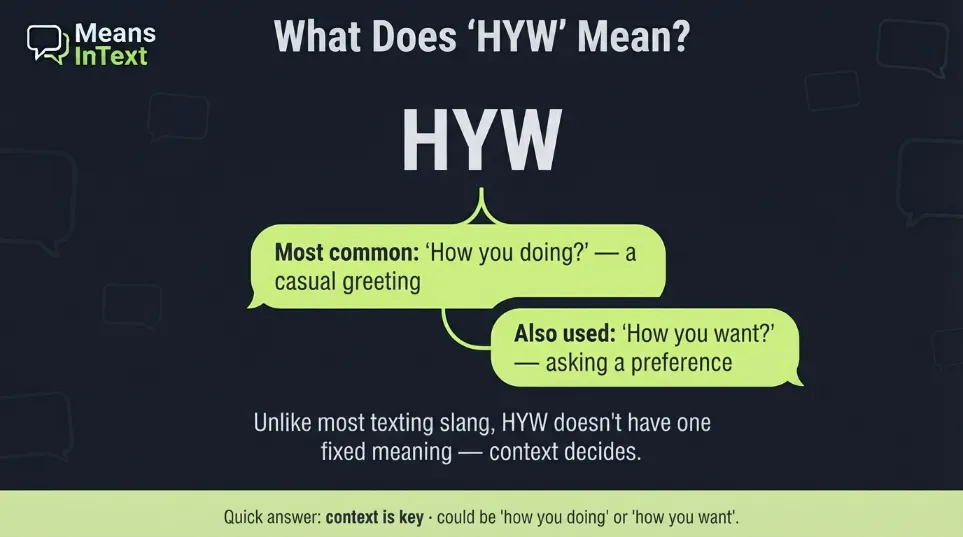
HYW is most often used as a shortened way of asking “How you doing?” or “How are you?” as a casual greeting. Depending on the conversation, it can also mean “How you want,” used when asking someone’s preference.
Simple breakdown:
- Most commonly used as a casual, shortened greeting similar to “how are you”
- Sometimes used to ask a preference, as in “how do you want to do this”
- Not a term with one single, widely agreed-upon definition
Example messages:
- “Hey, HYW? Haven’t heard from you in a while.”
- “We can meet at 7 or 8, HYW?”
- “HYW today, everything good?”
Origin & Background
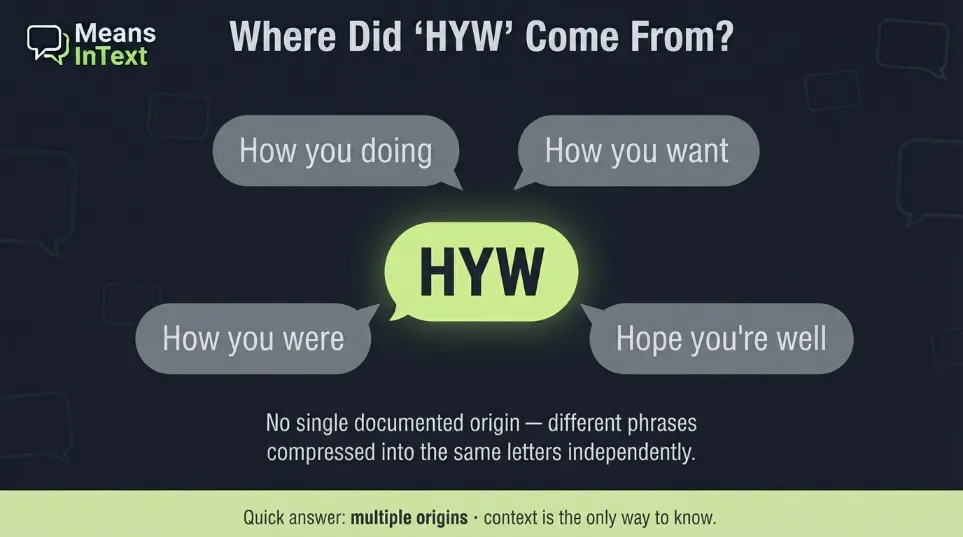
HYW doesn’t have a clear, documented origin the way established abbreviations like “LOL” or “BRB” do. It appears to have developed the way a lot of casual texting shorthand does — as a natural compression of a common spoken phrase, rather than from any single platform, trend, or creator.
Why the meaning varies so much
Because phrases like “how you doing,” “how you want,” and “how you were” all compress down to similar-looking letters, HYW ended up without one fixed, agreed meaning. Different people and different small communities seem to have arrived at slightly different expansions independently, which is why you’ll find real disagreement about its exact meaning even among sources that specifically cover texting slang.
Reading the sourcing honestly
A search for HYW‘s meaning turns up a wide range of confident-sounding but conflicting answers — “how you doing,” “how you want,” “hope you’re well,” “how you were,” and even “how you win” all show up as claimed definitions. That level of inconsistency is itself a useful signal: it suggests HYW hasn’t settled into one clear, widely recognized meaning the way more established slang has, and any single confident definition should be treated with some skepticism.
Where it sits today
HYW shows up occasionally in casual texting, mostly as an informal greeting or check-in, though it remains far less common and far less standardized than well-known abbreviations like “wyd” or “hbu.” Because of that inconsistency, context does most of the work in figuring out what a specific person means by it.
What this means for readers
Rather than pretending there’s a single settled answer, the most useful approach with HYW is to treat it as a flexible, informal check-in and let the rest of the message guide the interpretation. If someone follows it with a question about plans, they likely mean “how do you want.” If it stands alone as a greeting, “how are you” is by far the safest read.
Real-Life Conversations
1. Text Message (Greeting) Person A: Hey! HYW? Person B: Good, just got back from work. You? Person A: Same, pretty tired today
2. Group Chat (Greeting) Person A: HYW everyone? Person B: Doing alright, you? Person C: Can’t complain
3. Text Message (Asking Preference) Person A: We can meet at 7 or 8, HYW? Person B: 8 works better for me Person A: [INTERNAL LINK: related slang term] perfect, see you then
4. Text Message (Clarifying) Person A: HYW? Person B: Wait, what do you mean by that? Person A: Oh sorry, just asking how you’re doing
5. Casual Check-In Person A: HYW today Person B: Feeling productive, thanks for asking Person A: Nice, glad to hear it
6. Text Message (Genuinely Ambiguous) Person A: HYW Person B: Doing fine, or did you mean something else? Person A: Ha, just meant how are you, my bad for being vague
What It Really Means (Emotional & Social Context)
As a casual greeting, HYW carries a light, low-effort friendliness, similar to any short “how are you” check-in. It doesn’t demand a detailed response, and it fits naturally into casual, ongoing texting relationships where a quick check-in is enough.
As a preference question, it carries a more practical tone, simply asking someone to weigh in on a decision without much emotional weight attached.
Because the term itself is ambiguous, the biggest social factor at play is often the recipient’s confusion rather than any deeper meaning — if someone doesn’t recognize the abbreviation, a quick clarification usually resolves things without any awkwardness.
That said, within a specific friend group or ongoing conversation, HYW often settles into a fairly consistent, understood meaning between the people using it, even if that meaning wouldn’t be obvious to an outsider seeing it for the first time.
Also Read: What Does FFR Mean in Text: Full Meaning & Real Examples
Usage in Different Contexts
Its usage in casual texting between friends, HYW most often functions as a quick greeting or check-in, similar to “how’s it going.”
In planning or decision-making conversations, it can shift to mean “how do you want,” asking for someone’s preference on timing or details.
In professional settings, it’s best avoided. The term is too casual and too inconsistent in meaning to communicate clearly in work contexts.
Among people who text each other frequently, the exact meaning tends to stabilize quickly through repeated use, even without either person consciously agreeing on a definition — the pattern just becomes familiar over time.
When NOT to Use It
Given how inconsistent HYW‘s meaning is, a few situations call for caution.
- Avoid it with anyone unfamiliar with texting shorthand, since even people who do recognize casual slang may not know this specific term
- Consider spelling out the full question if clarity matters, since “HYW” alone can genuinely be read more than one way
- Skip it in professional or formal writing entirely
- If you receive “HYW” and you’re unsure what’s meant, asking for clarification is a completely reasonable response
Common Misunderstandings
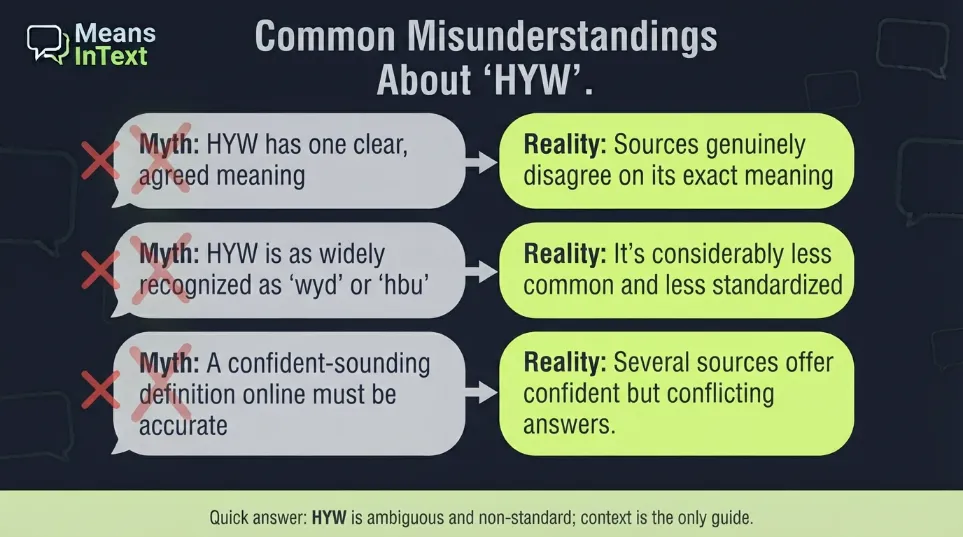
Myth: HYW has one clear, agreed-upon meaning. Reality: Sources disagree significantly on its exact meaning, ranging from “how you doing” to “how you want” to less common variations.
Myth: HYW is as widely recognized as “wyd” or “hbu.” Reality: It’s considerably less common and less standardized than those more established greeting abbreviations.
Myth: You can safely assume HYW always means the same thing. Reality: Given the inconsistency in how it’s used, it’s worth reading the full message for context clues rather than assuming a fixed meaning.
Myth: HYW is a recent invention. Reality: Like most organically developed slang, its exact origin and timeline aren’t clearly documented.
Myth: A confident-sounding definition online must be accurate. Reality: With a term like HYW, several sources offer confident but conflicting definitions, which is a sign to treat any single claimed meaning with some caution.
Comparison Table
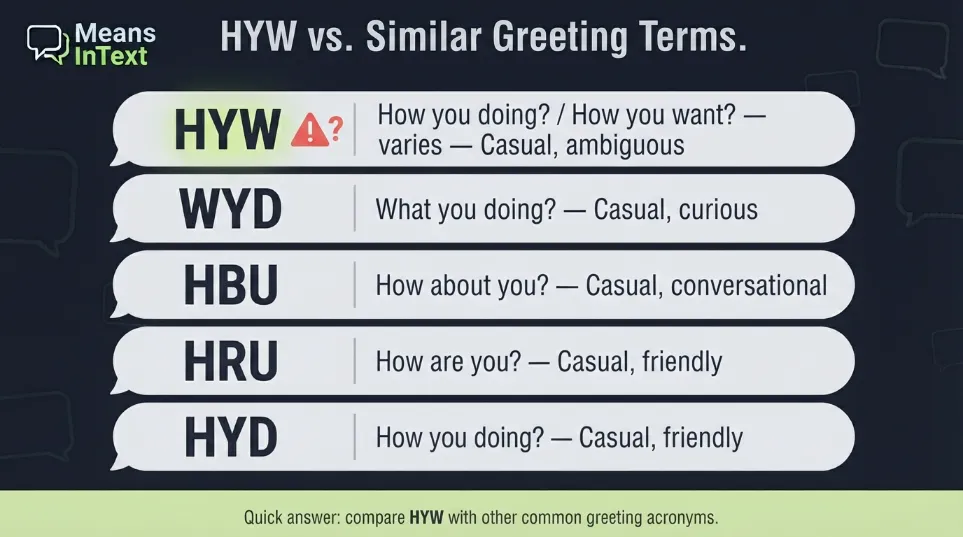
| Expression | Meaning | Tone | Usage |
| HYW | How you doing? / How you want? (varies) | Casual, ambiguous | Greetings, planning conversations |
| WYD | What you doing? | Casual, curious | Checking in on someone |
| HBU | How about you? | Casual, conversational | Reciprocating a question |
| HRU | How are you? | Casual, friendly | General greetings |
| HYD | How you doing? | Casual, friendly | General greetings |
Key Insight: HYW stands out as one of the less settled pieces of texting shorthand — unlike most abbreviations covered here, it genuinely lacks a single, well-documented meaning, which makes context more important than usual.
Variations / Types
- HYW today – Common phrasing for a casual daily check-in
- HYW? with no other text – Standalone greeting, most often meaning “how are you”
- HYW, meet at 7 or 8 – Common phrasing for the “how do you want” meaning
- HYW everyone – Group check-in variation
- just HYW-ing you – Playful, informal way to describe checking in casually
How to Respond When Someone Uses It
Casual: “Doing good, thanks! You?” Funny: “HYW back at you, whatever that means 😂” Mature: “All good here, how about you?” Respectful: “Doing well, appreciate you checking in.”
Regional & Cultural Usage
HYW doesn’t show a clear, well-documented regional or generational pattern, largely because its meaning itself hasn’t settled into one consistent form. Some sources suggest it’s more common among younger, social-media-active texters, though this isn’t backed by strong, consistent evidence.
There’s no reliable data suggesting a specific regional origin or concentration for the term, which is consistent with its overall lack of a clear, documented history.
This uncertainty is itself worth naming plainly: not every abbreviation floating around in texts and comment sections has a well-established, agreed meaning behind it, and HYW is a good example of that reality.
FAQs
What does HYW mean in a text message?
Most often, it’s used as a casual way of asking “how are you,” though it can also mean “how you want” depending on context.
Is HYW a common texting term?
It’s less common and less standardized than similar greeting abbreviations like “wyd” or “hbu.”
Why is there so much disagreement about what HYW means?
It doesn’t have one clear, documented origin, so different people and sources have arrived at different interpretations independently.
Is HYW the same as HWY?
No, HWY typically refers to “highway,” especially in navigation contexts, and is unrelated to the texting term.
Should I use HYW in professional messages?
No, it’s too casual and too ambiguous for professional communication.
What should I do if I don’t understand what someone means by HYW?
Asking for clarification is a reasonable and common response, since the term’s meaning genuinely isn’t fixed.
Should I trust a definition of HYW I find online?
It’s worth treating any single source with some caution here, since different sites offer noticeably different, sometimes contradictory definitions for the same term.
Conclusion
HYW is one of those texting abbreviations that resists a single, confident definition. Most often it functions as a casual greeting along the lines of “how are you,” though it can also ask about someone’s preference depending on the conversation. Given how much the claimed meanings vary across sources, reading the full context remains the most reliable way to understand it.
If you want more terms explained with the same honest, context-first approach, meansintext.com breaks them down one text at a time.
Also Read: What Does IKT Mean in Text? Full Meaning & Real Examples