

You saw XD at the end of a message and it looked like a random pair of letters at first. It’s not an acronym, though, and once you tilt your head sideways, the meaning clicks right away, it’s a face, not a word.
This guide breaks down what XD means, where it came from, and how it’s used today, decades after it first appeared. You’ll see real examples, tone notes, and how to reply if someone sends it your way.
What Does ‘XD’ Mean – Quick Meaning
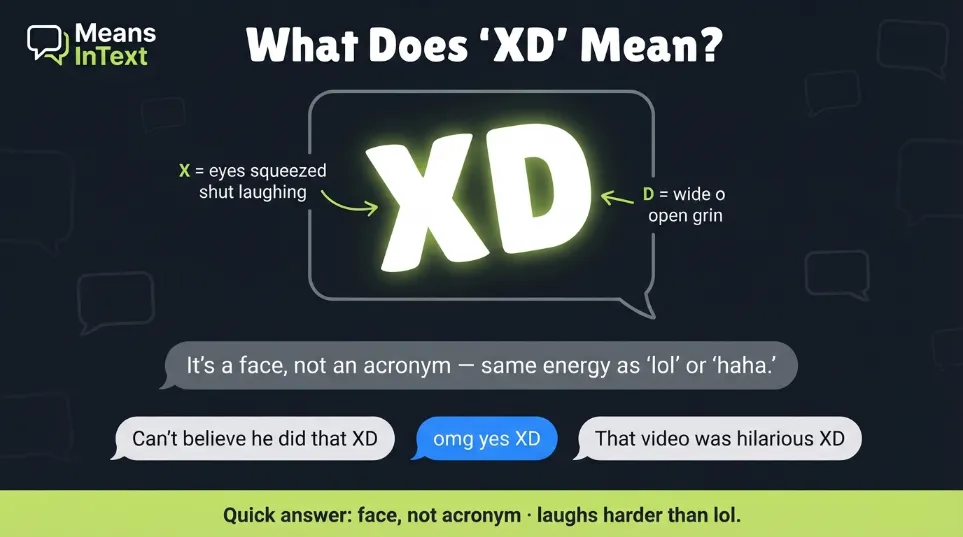
XD is an emoticon representing a laughing face. The “X” stands for eyes squeezed shut from laughing, and the “D” forms a wide, open-mouthed grin — together forming a sideways expression rather than an abbreviation of any kind.
Simple breakdown:
- Represents a laughing face, not an acronym or abbreviation
- Used the same way as “lol” or “haha,” to express amusement
- Always typed in capital letters, since lowercase “xd” doesn’t read the same way visually
Example messages:
- “That video was hilarious XD”
- “I can’t believe he actually said that XD”
- “XD you have to see this”
Origin & Background
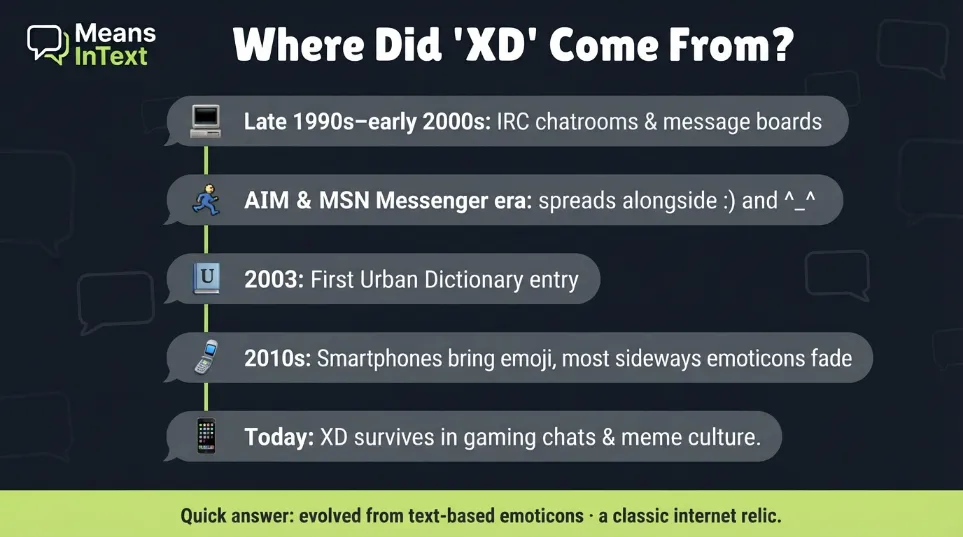
XD doesn’t have one single, documented origin story, but it likely emerged in the late 1990s and early 2000s in IRC chatrooms and early text-based message boards, well before smartphones or emoji existed.
How it spread
As instant messaging platforms like AIM and MSN Messenger grew in popularity, XD spread alongside other sideways text emoticons like “:)” and “^_^.” It became one of the most recognizable emoticons of that era, especially among teenagers chatting online. The first Urban Dictionary entry for it dates back to March 2003, describing it simply as a laughing face.
Why it survived emoji
Most text-based emoticons faded out once smartphones introduced built-in emoji keyboards in the 2010s, but XD held on. It got adopted by internet meme culture and gaming communities, where it remains common even now, often as a nostalgic callback to earlier internet chat culture rather than a replacement for modern emoji.
Not an acronym
Despite looking like two capital letters that might stand for something, XD isn’t an acronym at all. It’s purely visual — the letters form a face when read sideways, similar to how “:)” forms a smiling face. This distinguishes it from most texting slang, which is built from shortened words or phrases.
Where it sits today
XD remains common in gaming chats, comment sections, and casual texting among people who grew up with it or picked it up through online gaming and meme culture. It’s less common on platforms built primarily around image and video-based emoji reactions.
Why it still feels different from emoji
Even though modern phones offer a full emoji keyboard, XD persists because it carries a slightly different feel than a laughing emoji. Typing it out takes a bit more intention than tapping an emoji, which can make it read as more personal or nostalgic, especially among people who associate it with early internet friendships.
Real-Life Conversations
1. Text Message Person A: I tripped in front of the whole cafeteria today Person B: XD no way Person A: Everyone saw, I wanted to disappear
2. Gaming Chat Person A: I just got eliminated by my own landmine Person B: XD classic Person A: In my defense, I forgot I placed it
3. Group Chat Person A: My dog just stole an entire sandwich off the counter Person B: XD of course he did Person A: Not even a little bit of shame
4. Discord Person A: This meme is way too accurate Person B: XD I felt that Person A: [INTERNAL LINK: related slang term] same energy honestly
5. Instagram Comments User1: This caption is sending me User2: XD I can’t stop laughing User3: Underrated comment section honestly
6. WhatsApp Person A: I accidentally called my teacher “mom” today Person B: XD no you didn’t Person A: I wanted to sink into the floor
What It Really Means (Emotional & Social Context)
XD signals genuine amusement, similar to “lol” or “haha,” though it carries a slightly different, more visual quality. Because it’s a face rather than a word, it can feel a bit more expressive or playful than plain text alternatives.
People reach for it because it’s quick to type and instantly recognizable to anyone familiar with it, letting them react to something funny without needing extra words.
Picture a friend sending a genuinely funny story about their day. Replying with “XD” instead of a flat “lol” adds a bit more visual personality to the reaction, almost like sending a tiny drawn expression instead of just a word.
There’s also a small nostalgic quality to using it, especially for people who grew up with instant messaging. Typing “XD” can feel like a familiar, well-worn habit carried over from years of online friendships, rather than a deliberate stylistic choice each time.
Usage in Different Contexts
On gaming platforms and Discord, XD shows up constantly, reacting to funny in-game moments, fails, or banter between players.
Among friends who grew up with early internet or instant messaging culture, it fits naturally into casual texting, especially with people who already use it regularly.
In professional settings, avoid it. As an informal emoticon rooted in casual internet culture, it doesn’t fit workplace communication and can come across as unprofessional.
Among younger gamers who never used instant messenger platforms directly, XD often gets picked up secondhand through gaming culture rather than the original chatroom era, showing how the emoticon has been passed down across generations of internet users.
When NOT to Use It
XD works well in casual settings, but a few situations call for something else.
- Avoid it in professional or formal writing, where emoticon-based reactions don’t fit
- Don’t use it to react to anger, illness, or genuinely upsetting news, since it specifically represents laughter and would read as mismatched or confusing
- Be mindful using it with someone unfamiliar with older internet emoticons, since it may not register the same way it does for people who grew up with it
- Avoid overusing it in every message, since repetition can dilute its impact as a genuine reaction
Common Misunderstandings
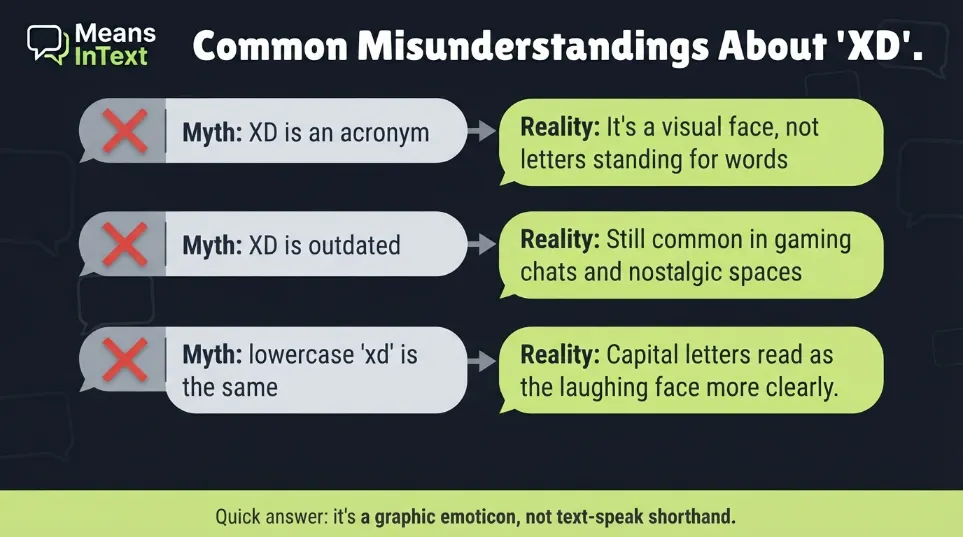
Myth: XD is an acronym standing for specific words. Reality: It’s a visual emoticon representing a laughing face, not an abbreviation built from words.
Myth: XD is outdated and no longer used. Reality: While less common than emoji, it’s still popular in gaming chats and nostalgic online spaces.
Myth: XD is appropriate in any casual setting. Reality: It’s too informal for professional or formal contexts, even relaxed workplace chats.
Myth: Lowercase “xd” means the same thing. Reality: It’s typically written in capital letters, since the lowercase version doesn’t visually form the same laughing face as clearly.
Myth: XD came from a specific meme or video. Reality: It doesn’t trace back to one specific moment or creator — it developed gradually within early chatroom and instant messaging culture.
Comparison Table
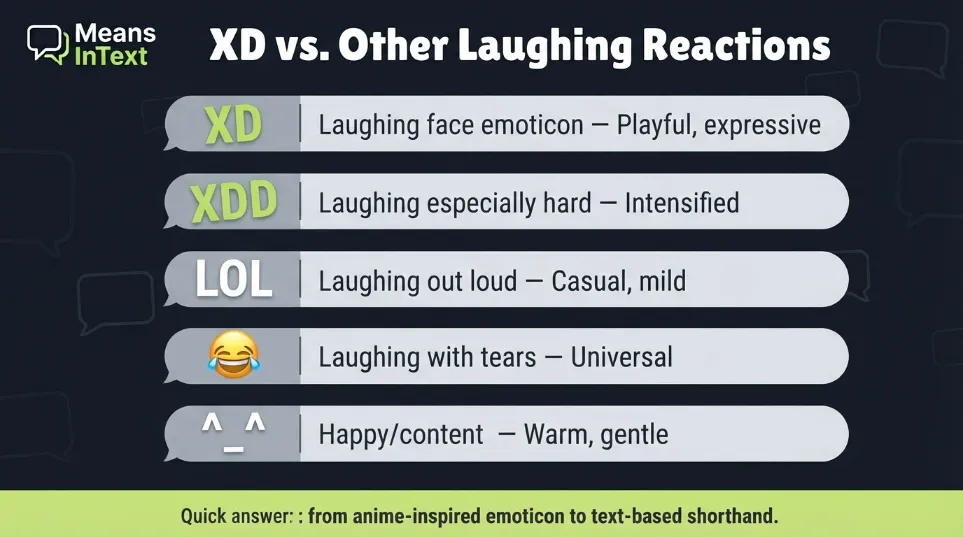
| Expression | Meaning | Tone | Usage |
| XD | Laughing face emoticon | Playful, expressive | Gaming chats, texts, comments |
| XDD | Laughing especially hard | Intensified, playful | Gaming chats, texts, comments |
| LOL | Laughing out loud | Casual, mild | General texting |
| 😂 | Laughing with tears | Expressive, universal | Texts, social media |
| ^_^ | Happy or content expression | Warm, gentle | Casual texting |
Key Insight: XD stands out because it’s a face, not a word, which gives it a distinctly visual quality that word-based laughter slang like “lol” doesn’t carry.
Variations / Types
- XDD – Adds emphasis, signaling stronger laughter
- XDDD – Further stretched for even more emphasis
- xd lol – Combines two laughter expressions for extra emphasis
- big XD – Playful way to describe intense amusement
- XD fr – “Laughing hard, for real,” adding sincerity
How to Respond When Someone Uses It
Casual: “Right?? Same.” Funny: “XD stop, I’m crying 😂” Mature: “Haha, that’s a good one.” Respectful: “Glad I could make you laugh.”
Any of these work fine, and matching the light, playful energy of the original message usually feels the most natural.
Regional & Cultural Usage
XD leans toward people with roots in early internet or gaming culture, spanning both older Millennials who remember its chatroom origins and younger gamers who picked it up through online communities. It’s less common among users who grew up primarily on platforms built around emoji reactions and short-form video.
There’s no strong regional split tied to country or language, since sideways text emoticons like XD spread through global internet chat culture rather than any single local slang scene.
It’s also worth noting that XD has strong roots outside English-speaking internet spaces too, remaining especially popular in gaming communities across parts of Europe and Asia, where it’s often used just as commonly as, or even more than, modern emoji.
Also Read: What Does SC Mean in Text: Full Meaning & Real Examples
FAQs
What does XD mean in a text message?
It’s an emoticon representing a laughing face, used the same way as “lol” or “haha.”
Is XD an acronym?
No, it’s a visual emoticon, not letters standing for specific words.
Is XD still commonly used?
Yes, especially in gaming chats and among people who grew up with early internet emoticon culture.
Should I use XD in professional messages?
No, it’s too casual and informal for work communication.
What’s the difference between XD and XDD?
XDD signals stronger, more intense laughter than plain XD.
Why is XD always written in capital letters?
Lowercase “xd” doesn’t form the same visual laughing face as clearly, so capital letters are standard.
Does XD get confused with anything else?
Occasionally with the design software “Adobe XD,” though context almost always makes clear which one is meant.
Conclusion
XD is one of the internet’s longest-lasting emoticons, dating back to early chatroom culture and still going strong decades later. It’s not an acronym at all, just a simple, expressive face that turns sideways text into a genuine laugh.
It’s also a rare survivor from an era before modern emoji existed, having outlasted most of its sideways-text peers by adapting into gaming culture and internet meme communities rather than fading out entirely.
Next time you see it, you’ll know exactly what’s behind those two letters. And if you want more terms explained the same clear way, meansintext.com breaks them down one text at a time.