

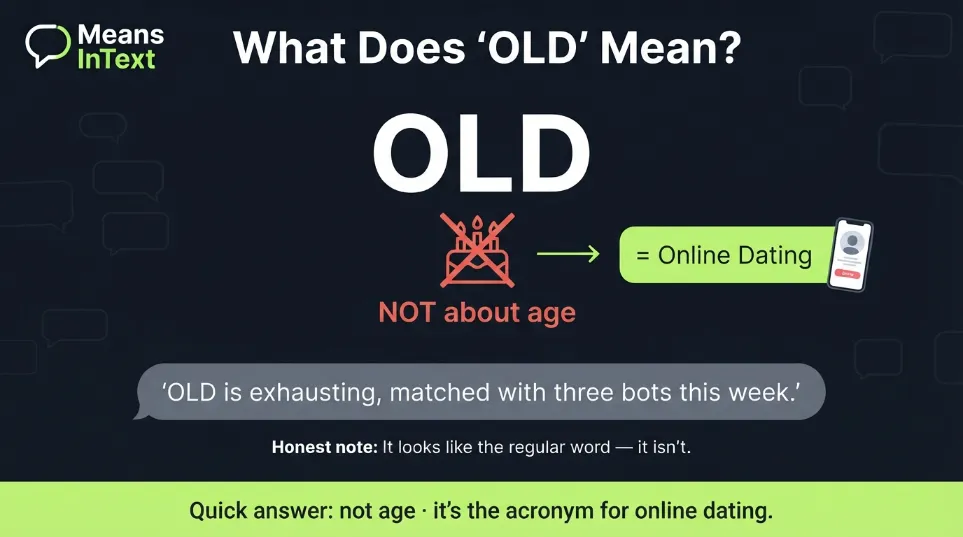
Quick Answer: OLD stands for "Online Dating." It's used to describe someone as active on dating apps, or to label a post, profile, or story as related to online dating. It has nothing to do with age — despite spelling out a word that usually means the opposite.
You’ve probably typed the word “old” a thousand times without thinking twice. But when it shows up in all caps, or as a tag on a dating story, it’s not talking about age at all.
Someone might text “back on the OLD grind” or caption a screenshot “OLD is rough out here.” That’s not a typo. It’s shorthand for something specific: online dating.
This guide explains what OLD means, where the abbreviation came from, and how people actually use it in texts, captions, and dating-app conversations.
What Does ‘OLD’ Mean – Quick Meaning
OLD stands for “Online Dating.”
It’s used as a noun to describe the whole activity — swiping, matching, messaging strangers, going on first dates that go nowhere. It’s also used as a tag to label content connected to that world.
Simple breakdown:
- It’s an acronym, not the regular word “old”
- It refers to dating through apps and websites, not in person
- Context makes the difference — capitalization and setting usually give it away
Example texts:
- “OLD is exhausting, matched with three bots this week”
- “Took a break from OLD, might delete the apps”
- “How’s OLD treating you?”
Origin & Background
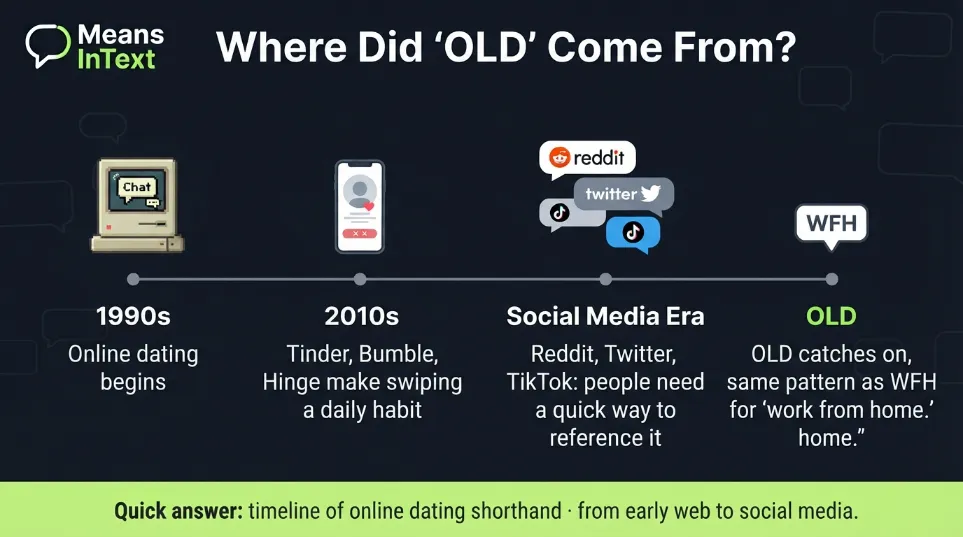
Online dating itself has existed since the 1990s, but the shorthand OLD came later, once dating apps like Tinder, Bumble, and Hinge made swiping a daily habit for millions of people.
As people started venting about the experience online — on Reddit, Twitter, and TikTok — they needed a quick way to reference it without typing “online dating” every time. OLD filled that gap the same way WFH filled it for “work from home.”
Wiktionary lists OLD directly as an internet abbreviation for online dating, separate from the everyday word “old.” It’s mostly used in written posts and captions rather than spoken out loud, since saying “old” instead of “online dating” out loud would just sound confusing.
Today, it’s most common in dating-advice communities and social posts complaining about — or occasionally celebrating — the swiping life. It hasn’t fully crossed into mainstream texting slang the way terms like RN or IMO have. Most people who use it are already deep in app culture and know their audience will get it instantly.
Real-Life Conversations
Text Message Person A: how’s the dating scene going Person B: OLD is a mess rn, everyone’s ghosting Person A: ugh same, might just delete the apps
Group Chat Person A: anyone else back on OLD Person B: yep, three apps and zero good matches Person C: I gave up on OLD months ago, met someone at work instead
TikTok Comments Person A: this is literally my OLD experience every single time Person B: the way you described that match is TOO accurate
Instagram Caption “Red flag count from one week of OLD: 7 🚩”
[INTERNAL LINK: what does ick mean in dating]
What It Really Means (Emotional/Social Context)
Using OLD signals something beyond the literal activity. It usually carries a tired, slightly sarcastic tone — like the person has been at this for a while and has stories to tell.
People reach for it when they want to vent without over-explaining. Saying “OLD” instead of “online dating” also creates a little in-group feeling. It tells other app users “I get it, you get it” without spelling out every bad date or unanswered message.
Picture someone posting a screenshot of a weird opening line they got on a dating app, captioned “another day, another OLD story.” That single acronym carries the exhaustion, the humor, and the shared experience all at once — no extra explanation needed.
Usage in Different Contexts
Social media: Very common here, especially in captions, memes, and dating-advice content on TikTok and Twitter/X.
Friends/casual: Comes up naturally when catching up on someone’s dating life over text.
Professional/work: Not appropriate. There’s no version of a work conversation where this abbreviation belongs — spell it out if it somehow needs to come up at all.
Dating apps themselves: Occasionally shows up in bios as shorthand for “yes, I know this is OLD, let’s skip the small talk.”
Also Read: What Does MTB Mean in Text? Full Meaning & Real Examples
When NOT to Use It
- With someone unfamiliar with dating-app culture — they’ll likely think you mean the word “old”
- In a professional setting, ever
- On a first date itself, where it can come off as jaded before things even start
- With family members who may not know the abbreviation and could take it literally
Common Misunderstandings
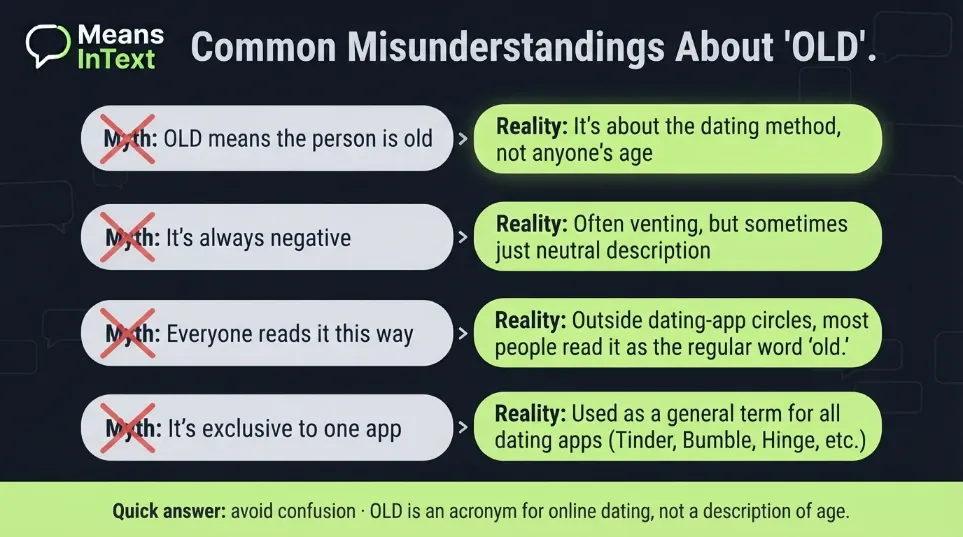
Myth: OLD means the person is old. Reality: It has nothing to do with age. It’s about the method of dating, not anyone’s years.
Myth: It’s always negative. Reality: While a lot of usage leans toward venting, some people use it neutrally, just describing their current dating method.
Myth: Everyone uses it this way. Reality: Outside dating-app circles, most people will read it as the regular word “old,” so context is everything.
Myth: It’s a new invention. Reality: Online dating has been around for decades — the acronym is just a shortcut that caught up to how common the activity became.
Comparison Table
| Expression | Meaning | Tone | Usage |
| WFH | Work from home | Neutral, informational | Describing a work setup |
| IRL | In real life | Neutral, contrasting | Distinguishing online vs. in-person |
| DTR | Define the relationship | Direct, sometimes tense | Asking where a relationship stands |
| SO | Significant other | Neutral, affectionate | Referring to a partner |
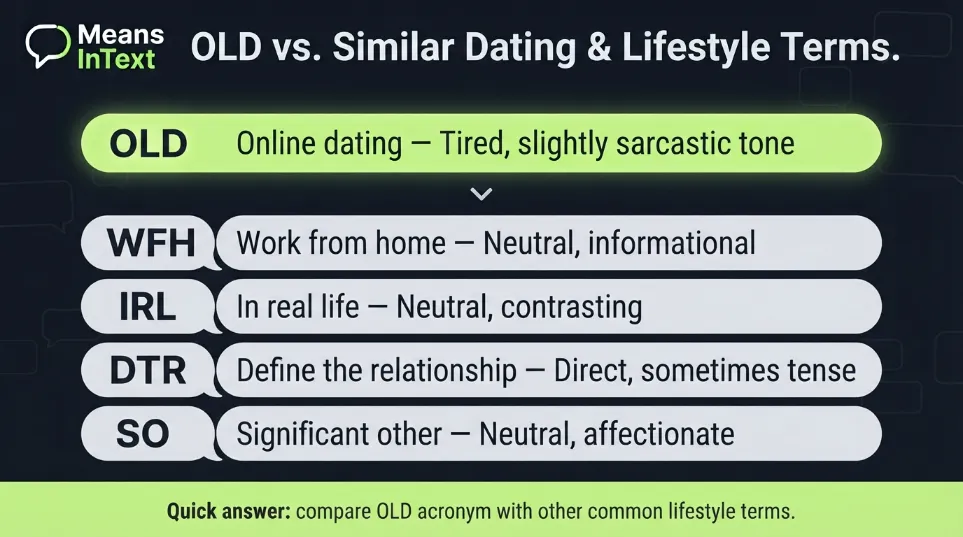
Key Insight: OLD works the same way WFH does — it takes a common but wordy phrase and turns it into something quick to type and instantly recognizable to the right audience.
Variations / Types
- OLD burnout – describes the exhaustion of swiping for a long time with no results
- back on OLD – returning to dating apps after a break or breakup
- quit OLD – stepping away from dating apps entirely
- OLD era – a phase of life defined by heavy app use
- OLD match – a connection made specifically through an app, as opposed to meeting in person
- OLD red flag – a warning sign spotted in a profile or early conversation
- OLD success story – a relationship that actually worked out from an app
- taking an OLD break – a temporary pause from apps, often for mental health reasons
How to Respond When Someone Uses It
Casual: “lol the OLD struggle is real”
Funny: “OLD really said ‘good luck’ and threw you to the wolves”
Mature: “sounds draining, are you thinking of taking a break from it?”
Respectful: “that sounds tough, hope the next match treats you better”
Also read: What Does JM Mean in Text: Full Meaning & Real Examples
FAQs
Does OLD mean the same thing as “old” in a regular sentence?
No. As slang, OLD is an acronym for online dating; the regular word “old” refers to age.
Where did the abbreviation OLD come from?
It grew out of online communities discussing dating apps, following the same pattern as other lifestyle acronyms like WFH.
Is OLD used in dating app bios?
Occasionally, usually as a quick way to reference the shared experience of using apps.
Why do people use OLD instead of just saying “online dating”?
It’s faster to type and signals shared understanding with people who already use dating apps.
Is OLD a negative term?
It can carry a tired or sarcastic tone, but it’s not inherently insulting — it mostly reflects the ups and downs of app-based dating.
Can OLD be confusing in a regular conversation?
Yes, especially with people unfamiliar with the term — they may assume you’re talking about someone’s age.
Conclusion
OLD takes a wordy phrase — online dating — and turns it into a quick tag people already understand. It’s less about literal age and more about a shared, often exhausting, experience of swiping and matching.
If you spot this acronym in a caption or text, read the context first. Chances are, someone’s talking about their app life, not their birthday. For more shorthand like this, meansintext.com breaks down what these terms actually mean.