

You saw SLO in a text and it’s short enough to look like a typo at first glance. In most casual texting, it isn’t one — it’s a quick way of asking someone to slow down, though the same three letters carry a couple of completely different meanings depending on the conversation.
This guide breaks down what SLO means in everyday texting, plus what else it can refer to in tech and location contexts. You’ll see real examples and clear guidance either way.
What Does ‘SLO’ Mean – Quick Meaning
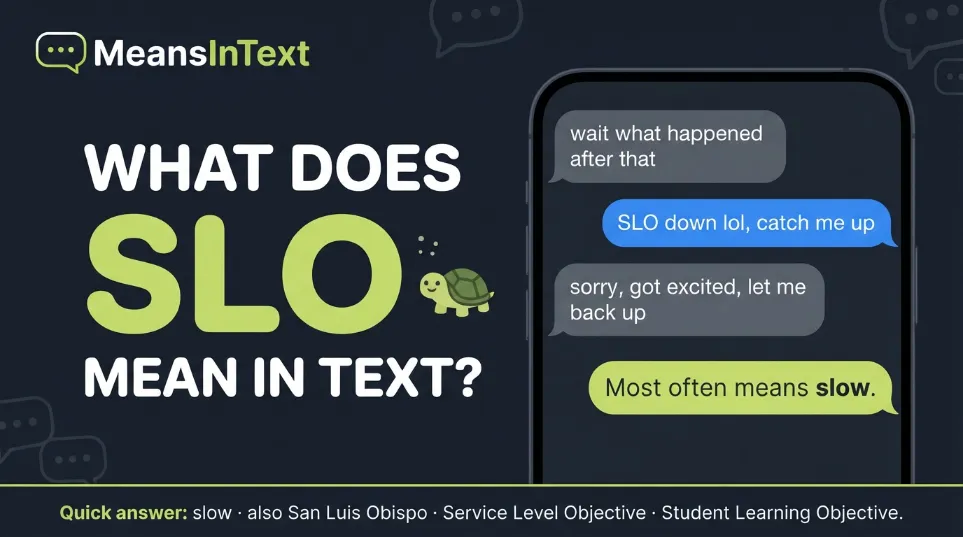
SLO most commonly means “Slow.” It’s typically used to ask someone to slow down, whether that’s how fast they’re typing, talking, or moving through a conversation.
Simple breakdown:
- Short for “slow,” often used as a request to slow down
- Common when someone’s having trouble keeping up with a fast-moving conversation
- Also used casually to describe something or someone moving at a slow pace
Example messages:
- “SLO down, I can’t keep up with all these messages.”
- “Type SLO, I’m having trouble following.”
- “Traffic’s so SLO today, running late.”
Origin & Background
SLO follows the same word-shortening pattern as plenty of other casual texting abbreviations, dropping vowels from “slow” to type it faster. It fits into the same category as shortening “message” to “msg” or “please” to “pls.”
How it’s used practically
The most common practical use of SLO is as a direct request, often sent by someone who’s struggling to keep pace with a fast-typing friend or a rapid back-and-forth in a group chat. Typing “SLO” is a quick way to ask for a breather without derailing the conversation.
Where it spread
This kind of straightforward abbreviation spread naturally through everyday texting rather than through any particular platform or trend. It’s a practical shorthand more than a piece of internet slang with a specific cultural origin.
Not always slang
Outside of casual texting, SLO has a couple of well-established, unrelated meanings. It’s commonly used as an abbreviation for San Luis Obispo, a city in California, especially among residents, students, and visitors referencing the area casually. In technology and software engineering, SLO stands for Service Level Objective, a specific target used to measure the reliability or performance of a system, commonly discussed in DevOps and site reliability engineering. In education, SLO can also stand for Student Learning Objective or Student Learning Outcome, used by teachers to describe specific goals for what students should learn.
Each of these meanings operates within its own distinct community, with little overlap. A software engineer discussing uptime targets, a teacher planning a lesson, and someone texting about California all use the same three letters for entirely different purposes, rarely crossing paths in the same conversation.
Where it sits today
The “slow” meaning remains the most common in everyday, casual texting. The other meanings are well established but confined to their specific fields — city references, tech discussions, or education contexts — rather than general slang.
Real-Life Conversations
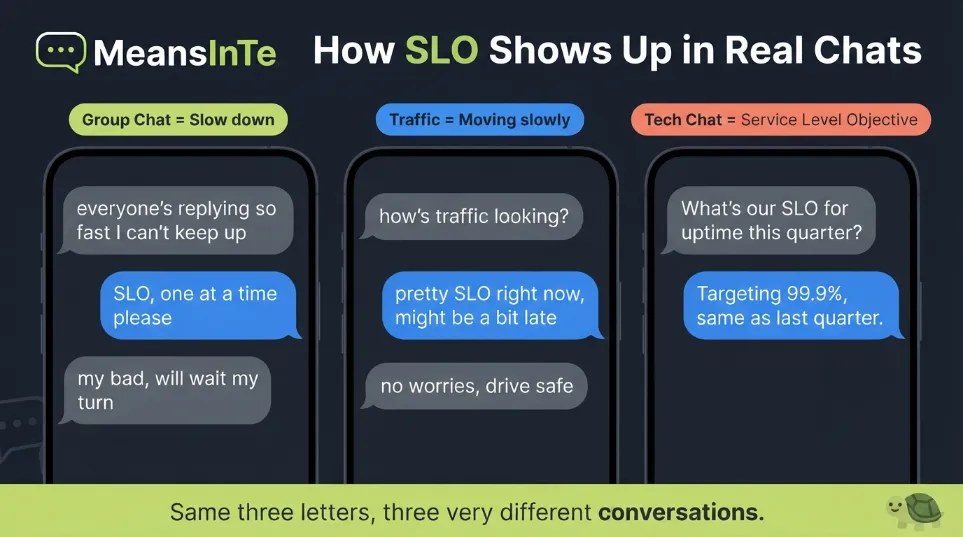
1. Text Message Person A: wait what happened after that Person B: SLO down lol, catch me up Person A: sorry, got excited, let me back up
2. Group Chat Person A: everyone’s replying so fast I can’t keep up Person B: SLO, one at a time please Person C: my bad, will wait my turn
3. Text Message (Describing Pace) Person A: how’s traffic looking? Person B: pretty SLO right now, might be a bit late Person A: no worries, drive safe
4. Text Message (San Luis Obispo) Person A: You still living in SLO? Person B: [INTERNAL LINK: related slang term] yep, love it out here Person A: Always wanted to visit
5. Tech Chat (Service Level Objective) Person A: What’s our SLO for uptime this quarter? Person B: Targeting 99.9%, same as last quarter Person A: Good, let’s make sure we’re tracking that closely
6. Text Message (Slow Response) Person A: You’ve been SLO to respond lately, everything okay? Person B: Yeah, just been buried at work Person A: No worries, take your time
What It Really Means (Emotional & Social Context)
As a request to slow down, SLO carries a small, practical kind of honesty. It’s an admission that a conversation is moving faster than someone can process, without needing to explain further or feel embarrassed about asking for a moment to catch up.
People reach for it because fast-paced group chats or excited storytelling can genuinely leave someone behind, and a quick “SLO” resets the pace without disrupting the flow too much.
Picture a group chat where several people are typing rapid-fire reactions to breaking news. Someone typing “SLO, what happened?” isn’t interrupting rudely — they’re simply asking the group to help them catch up before adding their own reaction.
That small request also does something socially useful. It keeps a conversation inclusive, making sure someone who’s falling behind doesn’t just quietly drop out of the discussion because they couldn’t keep pace with everyone else typing at once.
Usage in Different Contexts
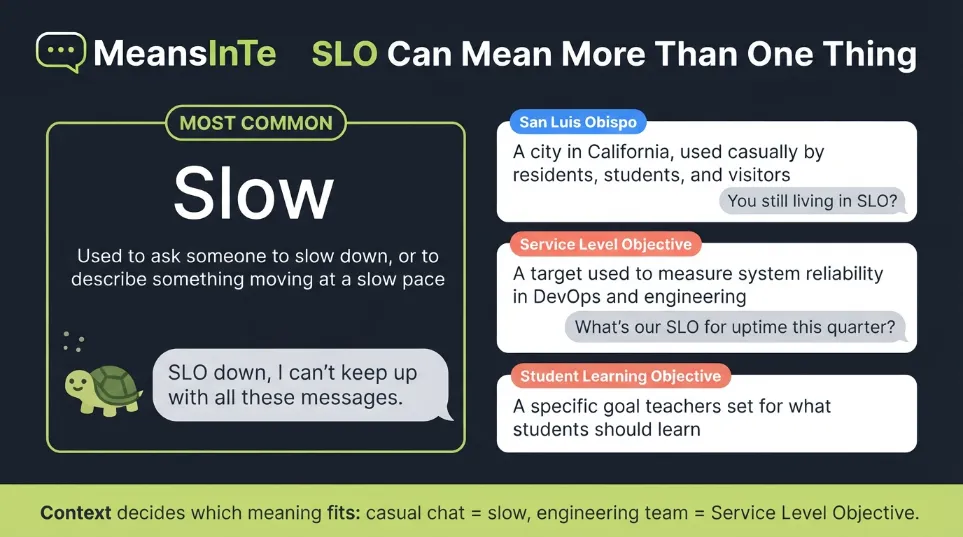
In fast-moving group chats, SLO works well as a quick, polite way to ask everyone to pace the conversation a bit more manageably.
Among friends texting casually, it can also describe something moving slowly, like traffic, a slow morning, or a delayed response, functioning simply as the shortened word itself.
In specific communities, like California residents or students, SLO commonly refers to San Luis Obispo, used the same way any city nickname would be in casual conversation.
In tech and education settings, SLO carries entirely separate, professional meanings tied to performance targets or learning goals, unrelated to the casual texting uses.
Among DevOps and engineering teams specifically, discussing an SLO often ties directly into broader conversations about system reliability, uptime commitments, and how closely actual performance matches agreed-upon targets.
When NOT to Use It
SLO is low-risk, but a few situations call for using the full word or being clear about context.
- Avoid it in professional writing outside of tech or education contexts, where spelling out “slow” is clearer
- Be aware that in tech and education conversations, SLO carries a specific, different meaning, so context matters
- Skip it with anyone unfamiliar with basic texting shorthand, since even simple abbreviations can occasionally cause a moment of confusion
- Use the full word if there’s any risk of the message being mistaken for a location or technical reference instead
Also Read: What Does LS Mean in Text? Full Meaning & Real Examples
Common Misunderstandings
Myth: SLO only means “slow.” Reality: It can also refer to San Luis Obispo, Service Level Objective in tech, or Student Learning Objective in education, depending on context.
Myth: SLO is rude to send. Reality: It’s generally a polite, practical way to ask someone to slow down, not a criticism.
Myth: SLO is trendy internet slang. Reality: It’s a straightforward word-shortening abbreviation without any particular cultural trend attached to it.
Myth: Everyone will understand SLO the same way regardless of context. Reality: In tech or education conversations, assuming the casual “slow” meaning could genuinely cause confusion.
Myth: The San Luis Obispo meaning is only used by locals. Reality: Visitors, students attending the local university, and people discussing travel plans use it just as often as longtime residents.
Comparison Table
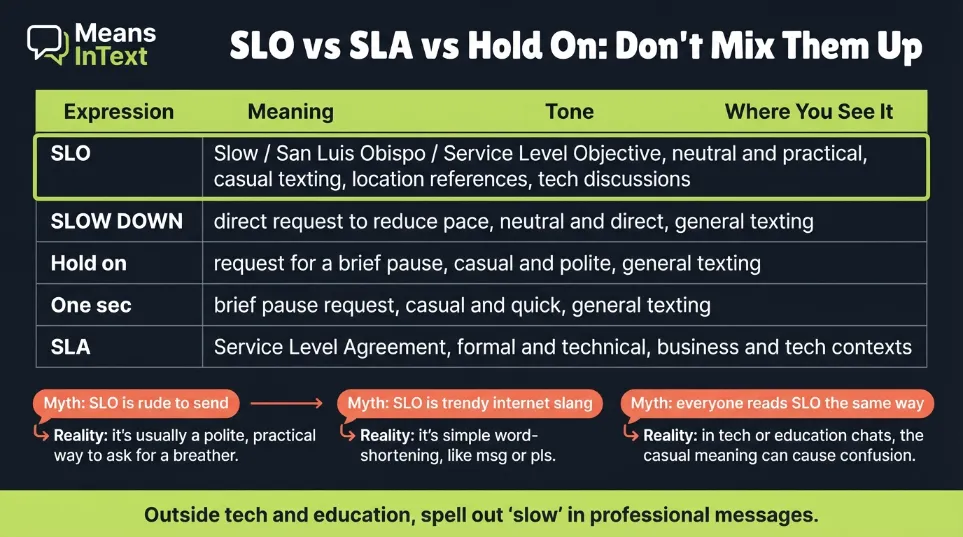
| Expression | Meaning | Tone | Usage |
| SLO | Slow / San Luis Obispo / Service Level Objective | Neutral, practical | Casual texting, location references, tech discussions |
| SLOW DOWN | Direct request to reduce pace | Neutral, direct | General texting |
| Hold on | Request for a brief pause | Casual, polite | General texting |
| One sec | Brief pause request | Casual, quick | General texting |
| SLA | Service Level Agreement | Formal, technical | Business and tech contexts |
Key Insight: SLO stands out because its casual meaning solves a very ordinary texting problem — keeping pace with a conversation — while its other meanings belong to entirely separate professional and geographic contexts.
Variations / Types
- SLO down – Common phrasing directly asking someone to slow their pace
- SLO pls – Adds politeness to the request
- SLO traffic – Refers to slow-moving traffic conditions
- SLO life – Casual reference to living in San Luis Obispo
- SLO target – Refers to a Service Level Objective goal in tech contexts
How to Respond When Someone Uses It
Casual: “Sorry, catching you up now.” Funny: “SLO mode activated 🐢” Mature: “No worries, let me slow down and explain.” Respectful: “Appreciate you letting me know, I’ll pace it better.”
Regional & Cultural Usage
The “slow” meaning of SLO doesn’t show a strong generational or regional split, since shortening common words like this is a fairly universal texting habit rather than slang tied to a specific group.
The San Luis Obispo meaning is naturally regional, tied specifically to California and especially common among people connected to the city through school, work, or residence. The tech and education meanings are used internationally within their specific professional fields, following industry-standard terminology rather than any regional pattern.
FAQs
What does SLO mean in a text message?
It most commonly means “slow,” often used to ask someone to slow down.
Is SLO rude to send someone?
No, it’s generally understood as a polite, practical request rather than criticism.
Does SLO mean anything else?
Yes, it can refer to San Luis Obispo, California, or in professional contexts, a Service Level Objective or Student Learning Objective.
Should I use SLO in professional messages?
Outside of tech or education contexts where it has a specific meaning, it’s better to spell out “slow” for clarity.
Is SLO common slang?
It’s more of a practical abbreviation than trend-driven slang, common in everyday casual texting.
How do I know which meaning of SLO is intended?
The surrounding conversation almost always makes it clear, since the meanings rarely overlap.
Is SLO ever used to describe a person rather than a situation?
Occasionally, casually calling someone “slo” can describe them as being slow to respond or act, though it’s typically said lightly rather than as a real criticism.
Conclusion
SLO is a simple, practical piece of texting shorthand, most often used to ask someone to slow down during a fast-moving conversation. Outside of casual texting, the same letters point to a California city or specific professional targets in tech and education, but context makes the intended meaning clear almost every time.
Next time you see it, you’ll know exactly what’s meant. And if you want more terms explained the same clear way, meansintext.com breaks them down one text at a time.
Also Read: EYP Mean in Text: Full Meaning Explained and Usage